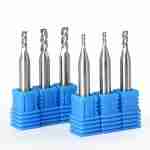
2 Flute long reach ball nose end milling cutter for Steel Description
A 2 flute long reach ball nose end mill for steel is a solid carbide cutting tool featuring a hemispherical tip geometry and an extended neck length, engineered to machine contoured surfaces, deep cavities, and spherical slots in ferrous materials. The ball nose profile generates smooth 3D cusp surfaces without sharp corner stress concentrations, making it the go-to tool for profile milling, cavity milling, and ball groove machining where standard-length tools cannot reach.
Also known as a ball mill, ball cutter, round nose end mill, or deep reach ball end mill in workshops and on shop floors, this tool is widely specified on engineering drawings as BN2FL-LR or 2F-BNE-LR in CNC programs. Procurement engineers and mold makers frequently search for it as a long reach carbide ball cutter or an extended ball nose end mill for mold making. Our full carbide end mill range covers every geometry required for complex steel machining programs.
Product Details

- Shank Dia (mm):6mm 8mm 10mm 12mm 14mm 16mm 20mm
- Flute Dia.(mm):2mm – 20mm
- Cutting Length (mm):4mm – 40mm
- Overall Length (mm):75mm – 150mm
- Flutes:2 Flutes; available for 1 flute, 3 flutes and 4 flutes
- HRC:HRC 45 / 50
- MOQ:1 pcs (standard) / 1-50 pc (custom)
- Quality Standards: DIN 6537 and DIN 6535-HA
| Brand | JYC Carbide |
| Model NO. | 2 Flute long reach ball nose end milling cutter for Steel |
| Product Item No. | JYC-NCG-2BL-D4-20 |
| Material | Tungsten Carbide (WC-Co) |
| Material Cobalt Content | Available for 6%-12% Usually 10%,12% |
| Material Hardness HV30 | Available 1660-2000 Usually 1660, 1700, 1780 |
| Grade | YG6 / YG8 / YL10.2/YK20UF/YK25UF/YK30SF |
| Coating | Uncoated / TiAlN / AlTiN / DLC |
| Grain Size | 0.2-1.0um Usually 0.4um, 0.5um ,0.7um |
| Density | 14.2-14.90 g/cm3, usually 14.2g/cm3, 14.5g/cm3 |
| Tooth Form | Spiral Tooth |
| Tooth Space | Sparse Tooth |
| Inspection Type for Finished Products: | 100% inspection (Visual inspection & Function inspection) |
| Traceability of Raw Materials: | Yes |
| Tolerance | h6 |
| Customization: | Available |
| Laser Logo | Available |
| MOQ | 1 pcs (standard) / 1-50 pc (custom) |
| Lead Time | 3–5 days (standard) / 7–30 days (custom) |
| Certification | ISO 9001 / ISO 14001 / ISO 45001 / ISO 50001 / COC |
| Custom Service | OEM / ODM accepted |
Products Pictures


Available Size:
| NO. | Order product No. | Size (mm) | Flutes | |||
|---|---|---|---|---|---|---|
| D | Handle D. | Cutting Length | Total Length | |||
| 1 | NCG-2BL-R1.0 | 2 | 6 | 4 | 75 | 2 |
| 2 | NCG-2BL-R1.25 | 2.5 | 6 | 5 | 75 | 2 |
| 3 | NCG-2BL-R1.5 | 3 | 6 | 6 | 75 | 2 |
| 4 | NCG-2BL-R1.75 | 3.5 | 6 | 8 | 75 | 2 |
| 5 | NCG-2BL-R2.0 | 4 | 6 | 8 | 75 | 2 |
| 6 | NCG-2BL-R2.5 | 5 | 6 | 10 | 75 | 2 |
| 7 | NCG-2BL-R2.75 | 5.5 | 6 | 12 | 75 | 2 |
| 8 | NCG-2BL-R3.0 | 6 | 6 | 12 | 75 | 2 |
| 9 | NCG-2BL-R3.5 | 7 | 8 | 14 | 75 | 2 |
| 10 | NCG-2BL-R4.0 | 8 | 8 | 16 | 100 | 2 |
| 11 | NCG-2BL-R4.5 | 9 | 10 | 18 | 100 | 2 |
| 12 | NCG-2BL-R5.0 | 10 | 10 | 20 | 100 | 2 |
| 13 | NCG-2BL-R6.0 | 12 | 12 | 24 | 100 | 2 |
| 14 | NCG-2BL-R7.0 | 14 | 14 | 28 | 100 | 2 |
| 15 | NCG-2BL-R8.0 | 16 | 16 | 32 | 150 | 2 |
| 16 | NCG-2BL-R10.0 | 20 | 20 | 40 | 150 | 2 |
* Non-standard sizes available upon request. Contact us for custom specifications,We will feedback to you within 24 Hours.
Applicability for Materials
◎ = Perfect for ○ = Suit — = N/A
| Carbon Steel | Alloy Steel | Pre-hardened Steel / Hardened Steel | Stainless Steel | Cast Iron / Nodular Cast Iron | Copper Alloy | Aluminium Alloy | Titanium Alloy | Heat-resistant Alloy | |||
|---|---|---|---|---|---|---|---|---|---|---|---|
| ~45HRC | ~50HRC | ~55HRC | ~68HRC | ||||||||
| ◎ | ◎ | ◎ | ○ | — | — | ○ | ◎ | — | — | — | — |
Key Technical Features & Specifications
This series of 2 flute TiAlN coated carbide ball end mills is built to outperform uncoated or TiN-coated alternatives in demanding steel applications. Every tool ships from long-term in-stock inventory, enabling short lead times for both sample orders and bulk production runs. Buyers evaluating a new carbide tool supplier will find our ISO-certified quality documentation available on request.
Specification Table
| Feature | Specification |
|---|---|
| Flute Count | 2 Flute |
| Helix Angle | >35° |
| Coating | TiAlN (gold-brown coated cutter) |
| Diameter Tolerance | D≤12mm: 0/−0.020 mm; D≥12mm: 0/−0.030 mm |
| Ball Radius Tolerance | R ±0.01 mm |
| Substrate | Ultra-fine grain solid carbide (tungsten carbide) |
| Reach | Long reach / extended neck |
Why TiAlN Coating on Steel?
The TiAlN (Titanium Aluminum Nitride) coating forms a stable Al₂O₃ oxide layer at high cutting temperatures, dramatically reducing crater wear when milling carbon steel, alloy steel, and pre-hardened steel up to HRC 45. This coated tool maintains hardness above 800 °C, outperforming TiCN in dry or semi-dry machining environments. Understanding the full science behind this substrate performance is covered in our guide to cemented carbide material properties.
Why Tight Tolerances Matter in Mold Work
The R ±0.01 mm ball radius tolerance ensures repeatable surface finishes across production runs — a critical spec when quoting mold cavity inserts or aerospace contoured parts where profile deviation is contractually limited. For a 2 flute carbide tool for steel, the >35° helix angle also improves chip curl and evacuation from deep pockets, reducing re-cutting and surface damage. Teams working on precision mold applications can also review our mold making end mills range for complementary tooling options.
Application Range & Compatible Materials
This long reach ball nose end mill for deep cavity milling is optimized for ferrous machining environments across mold shops, die casting tooling, and general precision machining. If you are evaluating tooling strategies for your production line, our die & mold machining application guide provides material-specific process recommendations.
Primary Materials — Best Performance
- Carbon steel milling (e.g., S45C, 1045): Ideal for general profile milling where chip evacuation and surface finish must be balanced. This tool is optimized for carbon steel machining at standard cutting parameters.
- Alloy steel cutting (e.g., P20, 4140, SCM440): The TiAlN coated end mill for alloy steel resists the abrasion and built-up edge common in chrome-moly grades.
- Pre-hardened steel up to HRC 45 (e.g., NAK80, P20+Ni, 718H): This carbide ball cutter for HRC 40–45 steel delivers smooth 3D finishes in mold cavity blocks without mid-job tool changes. See our dedicated resource on machining hardened steel for full parameter guidance.
- Cast iron & ductile iron (e.g., GG25, QT500): Optimized for cast iron milling where abrasive graphite inclusions rapidly wear uncoated tools — TiAlN provides the wear resistance needed.
Secondary Materials — Acceptable Performance
- Pre-hardened & through-hardened steel up to HRC 50 (e.g., Stavax, S136): Reduce feed rate by 20–25% and ensure flood coolant or MQL. This ball nose end mill for hardened steel up to HRC 50 performs reliably when cutting parameters are dialed in. For extreme-hardness jobs above HRC 60, refer to our solid carbide for hardened steel machining guide.
- Stainless steel (e.g., 304, 316L): Use with reduced depth of cut and increased coolant pressure to manage work hardening. Our stainless steel cutting tools page covers dedicated geometry options for this material group.
Industry Application Matrix
| Industry | Typical Operations | Material Grade |
|---|---|---|
| Mold & Die Making | Deep cavity milling, ball groove machining, core/cavity finishing | P20, NAK80, S136 |
| Automotive Tooling | Profile milling for stamping dies, rib milling | 42CrMo, GGG70 |
| General Machining | Contour milling, pocket finishing | 1045, 4140 |
| Aerospace Components | 3D contoured surface finish milling, long reach cavity work | 15-5PH, 17-4PH stainless |
| Hydraulic Equipment | Spherical slot machining, valve body cavities | QT600 ductile iron |
Purchasing Checklist — What to Confirm Before You Order
Buyers who skip these steps are the ones who call back with avoidable problems. Confirm all of the following before submitting a quote request. For a broader framework on evaluating tooling vendors, our carbide tool supplier evaluation checklist covers the full qualification process.
- Diameter & reach length — Match the tool reach to your deepest feature. Order 10–15% more reach than your pocket depth to allow for holder clearance.
- Ball radius tolerance requirement — Standard is R ±0.01 mm. If your drawing calls for tighter, confirm with our technical team before ordering. Review our standards and specifications FAQ for tolerance reference data.
- Workpiece hardness (HRC) — Tools optimized for HRC ≤45 and HRC 45–50 use different substrate grades. Ordering the wrong grade is the single most common cause of premature breakage.
- MOQ and packaging — Our standard MOQ is flexible for both sample and production orders. Request a sample first if you are qualifying this tool against a current supplier.
- Lead time — This product line is long-term in-stock. Standard orders ship within 1–3 business days. Custom dimensions require 7–15 business days; confirm lead time at time of order.
- Coating confirmation — All standard stock ships with TiAlN coating. If your application requires uncoated or AlTiN, specify at time of order.
- ISO certification documentation — We supply ISO-certified inspection reports and material certificates upon request. Specify if required for your incoming QC process.
Selection Guide — Choosing the Right Spec for Your Job
Use this decision framework to select the correct tool before you buy or request a price quotation. For a comprehensive overview of how to evaluate all end mill types for your application, our end mill selection guide covers geometry, coating, and substrate decision trees in full detail.
Step 1 — Determine Workpiece Hardness
- ≤HRC 45 → Standard TiAlN 2 flute long reach ball nose end mill (this series, primary recommendation)
- HRC 45–50 → Use this series with conservative parameters (see secondary material notes above)
- HRC 50+ → Upgrade to our hardened steel end mill series; contact us for a quote
Step 2 — Match Diameter to Surface Finish Requirement
- Smaller ball radius = finer scallop height = better surface finish but slower MRR
- For roughing passes in deep cavities: use the largest ball diameter your geometry allows
- For finishing passes on contoured mold surfaces: step down to the finish diameter, D≤12mm range
Step 3 — Confirm Reach vs. Rigidity Trade-Off
- Every 1× increase in length-to-diameter (L/D) ratio beyond 4:1 increases deflection risk
- For L/D > 6:1, reduce radial depth of cut (ae) by 30–40% and monitor for chatter
- Use the shortest long reach option that clears your workpiece — “longer is better” is the most expensive mistake in deep cavity milling
Step 4 — Choose Coolant Strategy
- Carbon & alloy steel: flood coolant or MQL both acceptable
- Hardened steel (HRC 40–50): MQL (minimum quantity lubrication) or dry preferred over flood to maintain thermal stability in the cutting zone
2 Flute vs. 4 Flute — Which Ball Nose End Mill for Steel?
The 2 flute design provides larger chip gullets, which is critical for long reach tools operating in deep cavities where chip evacuation is restricted. For full-slot or high-MRR roughing in open steel pockets, our 4 flute ball nose end mill delivers better material removal rates. Comparing both options side by side before committing to a geometry is the recommended approach for new job setups.
Real-World Failure Cases — What Went Wrong and Why
These are patterns observed across customer feedback and technical support cases. Learning from these prevents costly downtime. For a broader analysis of factors that determine tool longevity, see our in-depth article on tungsten carbide tool life.
Case 1: Premature Chipping on P20 at HRC 38 — Wrong Helix Angle
A European mold shop ordered a generic 2-flute ball nose end mill (30° helix, uncoated) for deep cavity finishing on P20 pre-hardened steel. The tool chipped at the ball tip within the first 10 minutes of cutting. Root cause: Low helix angle generated excessive axial cutting forces; the uncoated carbide substrate had insufficient abrasion resistance for continuous steel contact. Fix: Switch to a >35° helix, TiAlN-coated tool (this series). Tool life improved by 3–4×.
Case 2: Oversize Ball Radius on Mold Cavity Insert — Tolerance Specification Mismatch
A precision mold maker in Southeast Asia received a shipment of ball nose end mills from a low-price supplier. Post-machining CMM inspection showed ball radius deviation of R +0.04 mm — four times the acceptable tolerance. The entire cavity insert batch was scrapped. Root cause: Supplier had no traceable grinding QC process; R tolerance was not specified on the purchase order. Fix: Always specify R ±0.01 mm tolerance in your PO and request grinding inspection reports. Our ISO-certified production process holds R ±0.01 mm as a standard spec. Learn how to assess supplier quality rigorously with our OEM carbide tools guide.
Case 3: Tool Breakage on HRC 48 Steel — Hardness Misidentification
A customer ordered the standard carbon steel variant for a workpiece they believed was P20 (~HRC 30). On-site hardness testing later revealed the block had been through-hardened to HRC 48. Three tools broke within the first cavity. Root cause: Tool substrate optimized for sub-HRC 45 work; HRC 48 generated cutting forces that exceeded the tool’s transverse rupture strength at that L/D ratio. Fix: Always verify workpiece hardness with a portable Rockwell tester before specifying tooling. For HRC 45–50, order our solid carbide for hardened steel machining variant and reduce ae/ap by 25%.
Case 4: Poor Surface Finish on Ductile Iron — Incorrect Feed Rate
A supplier qualification test in an automotive die shop produced Ra 1.8 µm finish on QT600 ductile iron, against a drawing callout of Ra 0.8 µm. Root cause: Operator applied the same feed-per-tooth (fz) used for mild steel, which was 40% too high for ductile iron’s graphite structure. Fix: Reduce fz by 30–40% on the finishing pass for nodular/ductile iron. For proven strategies that directly reduce machining costs across steel and iron applications, review our article on how to extend carbide tool life and cut machining costs.
FAQs
Q1: What is the difference between a ball nose end mill and a ball mill or ball cutter?
A: They are exactly the same tool. “Ball nose end mill” is the standard technical designation used in engineering drawings and tooling catalogs. “Ball mill,” “ball cutter,” and “round nose end mill” are the common workshop and shop-floor names machinists use daily. When searching for suppliers or requesting a quote, either name will return the same product — just confirm the hemispherical tip geometry and the diameter tolerance before placing your order.
Q2: Can this 2 flute long reach ball nose end mill cut hardened steel above HRC 45?
A: This series is optimized for up to HRC 45 as a primary application. For hardened steel in the HRC 45–50 range, it can be used as a secondary option with reduced cutting parameters — lower feed rate (−20%), reduced radial depth of cut (ae), and MQL or dry cutting preferred over flood coolant. For steel above HRC 50, we recommend upgrading to our dedicated hardened steel series. Contact us to discuss the right selection for your specific hardness and geometry before placing an order.
Q3: Why choose a 2 flute design over a 4 flute ball nose end mill for steel milling?
A: The 2 flute design provides larger chip gullets, which is critical for long reach tools operating in deep cavities where chip evacuation is restricted. In profile milling and cavity finishing applications, chip re-cutting damages the workpiece surface and accelerates tool wear. The 2 flute geometry reduces this risk, especially at high L/D ratios. For full-slot or high-MRR roughing in open steel pockets, a 4 flute variant delivers better material removal — contact us for a price comparison between the two series.
Packaging & Delivery
| Packaging | Individual plastic tube + foam box |
| Port | Shenzhen / Guangzhou /Shanghai |
| Lead Time | 3–5 days (in-stock) / 7–30 days (custom) |
| Shipping | DHL / FedEx / UPS / Sea freight |
FAQs
Q:
A:
Q:
A:
Q:
A:
A VISIBLE QUALITY. YOU CAN BE TRUSTED.
01
Please confirm the tool size, coating type, and material compatibility before placing an order.
02
Carbide end mills are fragile – avoid impact and store them in a dry, secure place.
03
Ensure proper cutting parameters (speed, feed, depth) for best performance and tool life.
04
Wear safety protection (goggles, gloves) when operating cutting tools.
05
If you’re not sure which type to choose, feel free to contact us for professional recommendations.
Purchase Information
After-sales Support: We offer technical guidance and quick response for any product or usage concerns.
MOQ & Customization: Most models are in stock. Custom logo, size, or packaging is available – please consult before ordering.
Shipping: We support express, air, and sea shipping. Delivery time may vary by region and quantity.
Quality Assurance: All tools are inspected before shipment. We provide SGS and ISO certificates upon request.
Returns & Warranty: Defective or damaged products due to manufacturing issues can be replaced.
Shipping Terms
If you have any special requirements on packing, please contact us for shipping cost and lead time. See our general Shipping & Return Policy for details.
2 Flute Long Reach Ball Nose End Mill for Steel | JYC Carbide

2 flute long reach ball nose end mill for steel — TiAlN coated, R±0.01mm, HRC45, 0 MOQ, fast lead time. Get a quote from carbide factory in China.
Product SKU: JYC-NCG-2BL-D4-20
Product Brand: JYC Carbid
Product Currency: USD
Product Price: 8
Price Valid Until: 2036-12-12
Product In-Stock: InStock
4.86


Request a Quote for Carbide Tools