Cemented Carbide Material
Author: JYC Carbide Application Engineering Team | Reviewed by: Senior Carbide Materials Engineer | Last updated: 2026
Cemented carbide is not a type of steel. It is a ceramic–metal composite made from hard carbide grains, typically tungsten carbide (WC), bonded together with a metallic binder such as cobalt, nickel or iron under high temperature and pressure.
This structure gives cemented carbide a combination that is hard to find elsewhere: hardness close to advanced ceramics, but with much higher bending strength and impact resistance. In metal cutting tools and wear parts, it has been a mainstream choice for nearly a century and still plays a central role today. For an overview of how JYC Carbide positions itself in this field, see the About Us page.


From Lab Concept to Production Floor
Key milestones in cemented carbide
- Late 1890s–early 1900s: Carbide materials are synthesized and studied in the lab, laying the foundation for powder metallurgy.
- 1923: Krupp in Germany patents cemented carbide manufacturing and launches the WIDIA brand (“Wie Diamant” – “like diamond”), bringing cemented carbide into industrial metalcutting.
- 1930s–1950s: TiC, TaC and other carbides are added to tailor grades for steels, cast irons and non‑ferrous alloys, forming the familiar P/M/K grade families.
- 1960s–1980s: CVD and early PVD coatings (TiC, TiN, TiCN) become common, significantly improving wear resistance of carbide inserts and tools.
- 1990s–2010s: Fine‑grain and sub‑micron substrates (around 0.2–0.8 μm) combined with multi‑layer PVD coatings enable higher cutting speeds, higher feeds and more stable dry or semi‑dry machining.
- 2015–2025: More specialized grade design, nano‑structured coatings and customized carbide blanks support high‑speed milling, hard milling, dry cutting and complex cavity machining in molds and aerospace.
If you want to dive deeper into machining fundamentals that build on these developments, the Machining Knowledge section in the Carbide Technical Hub offers more process‑focused articles.
These milestones describe the dominant direction of cemented carbide development. They do not mean ceramic, CBN or PCD tooling is less important. In practice, cemented carbide often works alongside these materials rather than replacing them.
Cemented Carbide vs Other Tool Materials
Values below are typical engineering ranges meant to show trends and relative levels. Exact numbers depend on grade, microstructure and test method. For design work on a specific grade, use the data sheet and relevant standards, and see JYC Carbide’s standards and specifications FAQ for common ISO and DIN references.
Hardness comparison
| Material | Typical hardness (HV) | Notes |
|---|---|---|
| Cemented carbide | ≈1500–2400 | High wear resistance for cutting tools and wear parts. |
| High speed steel (HSS) | ≈800–1000 | Lower hardness, suitable for lower speed or general tooling. |
| Engineering ceramics | ≈1800–3000 | Very hard but more sensitive to impact and thermal shock. |
| CBN / PCD | ≈3500–8000 | Superhard materials for specific, demanding applications. |
Cemented carbide tool sits clearly above HSS in hardness and slightly below some ceramics and CBN/PCD. In practice this allows higher cutting speeds and better resistance to abrasive wear than HSS, while retaining more toughness than most ceramics and superhard materials.
Strength and toughness
Typical bending strength / transverse rupture strength ranges:
- Cemented carbide product: roughly 1800–3500 MPa depending on grade.
- HSS: roughly 3000–4000 MPa.
- Engineering ceramics: often around 500–900 MPa.
- CBN / PCD: frequently around 800–1500 MPa.
Compared with most ceramics and superhard materials, cemented carbide has much higher bending strength and impact tolerance, so it copes better with interrupted cuts, variable loads and real‑world clamping conditions. Compared with HSS, some high‑performance steels may show higher ultimate bending strength, but the lower hardness and wear resistance limit cutting speed and tool life.
Hot hardness and temperature capability
Looking at hot hardness and usable temperature range:
- Cemented carbide typically maintains useful hardness up to around 900–1000 °C under cutting conditions.
- HSS is usually limited to about 550 °C before softening becomes a problem.
- Ceramics can run at higher temperatures but are more sensitive to thermal shock and impact.
- CBN and PCD can withstand even higher temperatures in specific applications but at higher material and tool costs.
Cemented carbide occupies a middle ground that fits production machining well: it can operate at attractive cutting speeds and temperatures without the cost level and application constraints of some superhard materials. For process planning in high‑HRC steels, you can see how this plays out in the machining hardened steel guide.
Thermal expansion and dimensional stability
Typical coefficients of thermal expansion (CTE):
- Cemented carbide: about 4.5–6.0 × 10⁻⁶/K.
- HSS: about 11–13 × 10⁻⁶/K.
- Many ceramics: roughly 4–8 × 10⁻⁶/K depending on composition.
A relatively low CTE helps cemented carbide keep dimensions more stable under changing temperatures. That matters for precision wear parts and tools that see repeated thermal cycling, because it can reduce growth‑related dimensional drift compared with materials with higher expansion.
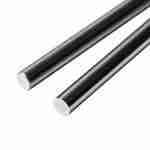
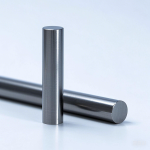
When those precision parts start as ground rod or blanks, material choice and tolerance control begin at the blank stage. For examples of standard rod options, see the carbide rod product range.
Thermal conductivity
Typical thermal conductivity levels:
- Cemented carbide: often around 80–110 W/m·K.
- HSS and many ceramics: often around 20–40 W/m·K.
- CBN / PCD: can reach much higher values in some grades.
Higher thermal conductivity helps move heat away from the cutting edge and contact zone. Cemented carbide can therefore carry heat away through the tool body more effectively than many HSS and ceramic tool materials. Coolant strategy and toolpath still play a major role in managing heat.
Cost and availability
From a cost and availability standpoint:
- HSS has relatively low material and manufacturing cost and remains attractive for low‑speed, low‑volume or general‑purpose tools.
- Cemented carbide has a higher material cost, but in mass production its higher speed and tool‑life potential often improve cost per part compared with HSS.
- Ceramics, CBN and PCD cost more and are usually reserved for specific high‑value or extreme applications.
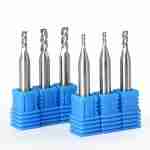
Rather than saying any one material is “the best,” a more accurate statement is: for many established applications in metalcutting, cold forming and wear parts, cemented carbide offers a strong balance of hardness, toughness, temperature resistance and cost. If you want to see how this carries through to everyday cutters, the carbide end mills and carbide drills catalogs show typical tool geometries built on these materials.
Where Cemented Carbide Is Used Today
Industry reports and market data differ in detail, but they generally agree on how cemented carbide demand is distributed across major applications:
- Metalcutting tools: inserts, solid end mills, drills and reamers together account for roughly half or slightly more of global cemented carbide usage.
- Cold heading and cold extrusion dies: a significant portion goes into fastener and forming tooling where high compressive strength and wear resistance are critical.
- Mining and construction tools: bits, buttons and wear tips for drilling and crushing equipment consume a notable share.
- General wear parts: nozzles, seal rings, gauge blocks, valve components and other precision wear parts also rely on cemented carbide.
- Other specialized uses: certain aerospace, defense or energy applications use cemented carbide in smaller but technically demanding roles.
Instead of focusing on exact percentages, it is more practical to think like this:
- If the job is “metalcutting plus production volumes,” cemented carbide tooling will almost always be on the shortlist.
- If the component faces “high hardness or strong impact plus dimensional control,” cemented carbide is often one of the first materials to consider for wear parts or tooling.
For concrete examples of how cemented carbide tools are applied, you can browse the Applications section, including die & mold machining, automotive machining and aerospace machining.
Actual material selection still depends on part value, process capability, tolerances and the economics of your specific operation.
Looking Ahead: Co‑Existence With Other Materials
From a process engineer’s perspective, cemented carbide will remain important for the foreseeable future in:
- High‑speed milling, hard milling, turning and boring of steels, cast irons and many alloys.
- Cold heading, cold extrusion and stamping dies, plus associated punches, sleeves and inserts.
- Mining, oil & gas and construction wear parts where impact and abrasion occur together.
At the same time, it is important not to treat cemented carbide as the only “correct” choice:
- For extremely high temperatures, very high hardness or certain precision surfaces, ceramics, CBN and PCD may offer better performance despite their cost.
- For cost‑sensitive, low‑speed or consumer‑grade tools, HSS still offers a good balance of performance and price.
- For composites, nickel‑based superalloys and high‑end molds, it is common to combine cemented carbide with other materials and processes (for example ceramic inserts, PCD tools, EDM and grinding) rather than expecting one material to do everything.
A realistic view is that cemented carbide will continue to be a workhorse material in many cutting and wear applications, while evolving in grade design, coatings, recycling and process control. Other tool materials will grow in parallel and complement it in areas where they make more sense technically or economically. If you are interested in the sustainability angle, JYC’s sustainable carbide tool solutions article discusses how carbide tools fit into longer‑term sustainability planning.
What JYC Carbide Brings to the Table
JYC Carbide (Jinyuchang Industrial Technology Co., Ltd) ‘s supported manufacturer about 270,000 m² of carbide manufacturing and grinding facilities. The factory offers more than 5,000 SKUs of standard and special carbide tools and blanks, supports over 1,200 active customers, has delivered more than 40 million pieces, and serves customers in more than 40 countries and regions. More background on this footprint is available on the Our Advantage page.
Core equipment includes CNC tool grinders from P3 WALTER, ANCA and ROLLOMATIC, plus ZOLLER presetters, laser measuring systems, FEI microscopes and CMMs for geometry and surface inspection. JYC Carbide runs under ISO 9001, ISO 14001, ISO 45001 and ISO 50001 management systems and can supply outgoing inspection reports and Certificates of Conformity (COC) with shipments. SGS and other third‑party reports can be arranged as paid services agreed at the RFQ stage, instead of being promised for every order.
The intent of this article is to explain cemented carbide from an engineering perspective, not to promise specific life multipliers or defect rates for any one product. In real projects, tool life, machining efficiency and dimensional stability all depend on the material batch, machine condition, fixturing, programming and operator practice. Final performance needs to be confirmed by test cuts and data on your own equipment. For guidance on evaluating suppliers when you reach that stage, you can refer to the carbide tool supplier evaluation guide.
What to Prepare Before You Switch to Cemented Carbide
When you are evaluating a move to cemented carbide for tools or wear parts, the following information helps an engineer give practical recommendations:
- Application type: metalcutting tool, cold forging die, wear part, mining button, or something else.
- Load conditions: continuous vs interrupted cutting, impact level, vibration or thermal cycling.
- Workpiece material and hardness: for example 42CrMo, H13, D2, cast iron, nickel‑based alloys, plus the HRC or HB range.
- Dimensions and tolerances: critical dimensions, tolerance classes (for example ISO fits), surface roughness targets and allowed deformation.
- Current issues: excessive wear, chipping, plastic deformation, dimensional drift, low throughput, or other specific problems.
With that input, an applications engineer can:
- Suggest a suitable carbide substrate range and typical grain size window, and whether a standard carbide rod or a non‑standard carbide product is the better starting point.
- Advise whether coatings are recommended and which coating families to consider.
- Propose a starting window for cutting data (Vc, fz, ap, ae) if the part involves machining, and point you to relevant tool families such as carbide end mills, carbide reamers or solid carbide twist drills.
- Indicate where other tool materials (ceramic, CBN, PCD) might play a role alongside carbide rather than being replaced by it.
Any discussion of potential life improvement or cost reduction should be treated as engineering guidance based on similar cases, not as a fixed promise. Whether those gains can be achieved in your operation ultimately depends on sample cuts, production trials and cost analysis under your own conditions.
FAQs
What is cemented carbide made of?
Cemented carbide is a composite of hard tungsten carbide grains and a metallic binder like cobalt, nickel or iron, sintered together under high temperature and pressure.
How does cemented carbide compare to ceramic, CBN and PCD?
Cemented carbide offers more toughness than most ceramics and superhard materials, with lower cost, while ceramics, CBN and PCD target more extreme or very specific applications.
Is cemented carbide tool suitable for hard milling and die machining?
Yes, cemented carbide tool is widely used for hard milling and die/mold work, especially with HRC steel, but success depends on the right grade, coating, toolpath and machine rigidity.
Discuss a solution for your parts
We will review your material, loading conditions and accuracy targets, then provide recommendations tailored to your machining and tooling requirements.
If you prefer to start with a brief description instead of a full RFQ, you can also send your questions via the message page so an engineer can follow up with you.
Technical content reviewed for alignment with JYC Carbide factory capabilities (ISO 9001 / 14001 / 45001 / 50001, COC available on request). Performance expectations described here are general and should always be validated by test cuts and measurements under your own conditions.


Request a Quote for Carbide Tools