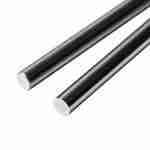
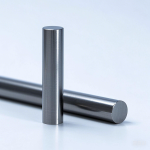
YK35SF Ultrafine Cemented Carbide Rod — 9% Cobalt, 0.4 μm Grain
Hardened Steel Finishing · Graphite Electrode Milling · Aluminum Mirror-Surface Machining · Composite Material Cutting
Who Makes This Rod — and Why It Matters
We are a fully integrated tungsten carbide manufacturer — from raw tungsten powder through to finished, precision-ground rod stock and cutting tools. Operating a 270,000 m² facility with an annual output of 1,200 metric tons of cemented carbide rod profiles, every YK35SF rod is produced under an ISO 9001 certified quality system.
Learn more about our manufacturing capability and competitive advantages →

1. Series Positioning
The YK35SF is an Ultrafine Cemented Carbide Rod built on a 91% WC + 9% Co formulation, with a WC grain size of 0.4 μm. At this grain scale — classified as ultrafine-grained cemented carbide per ISO 4499-2 — the cobalt binder phase wraps more uniformly around each carbide grain. This is why the material achieves HRA 93.4 hardness and ≥10 MPa·m¹/² fracture toughness simultaneously. These two properties normally trade off against each other in the WC-Co system; the ultrafine grain structure is what allows both to coexist.
A 9% cobalt content is the industry’s most widely used balance point for precision cutting tool substrates. It is harder and more wear-resistant than 12% Co grades, yet meaningfully tougher than 6% Co grades when edge integrity on interrupted or variable cuts is a concern.
Best Suited For:
- Tool manufacturers producing solid carbide end mills, drills, reamers, and engraving tools requiring ultrafine grain substrate
- Machine shops finishing hardened steels (HRC 45–65), graphite electrodes, aluminum alloys, and CFRP/GFRP composites — see our die & mold machining solutions
- Manufacturers requiring mirror-surface finishes on stainless steel or aluminum (smartphones, laptops, medical housings, aerospace structural skins)
- Precision component production in aerospace, medical devices, automotive dies, and 3C electronics
Not the Right Choice For:
- Heavy interrupted cutting or high-impact roughing — a 12–15% Co grade offers better shock resistance; explore our carbide inserts for heavy-duty applications
- Applications where lowest unit price is the primary driver and tool life consistency is secondary. Ready to source YK35SF rod stock?
Request a quote with your diameter, length, and quantity →
2. Chemical Composition
| Grade | WC % | Co % |
|---|---|---|
| YK35SF | 91 | 9 |
3. Physical Properties & Microstructure
| Property | Unit | Value |
|---|---|---|
| Density | g/cm³ | 14.5 |
| Hardness | HV30 | 1920 |
| Hardness | HRA | 93.4 |
| Transverse Rupture Strength | N/mm² | ≥ 4,200 |
| Porosity | — | ≤ A02B00 |
| Free Carbon | — | ≤ C00 |
| η Phase | — | ≤ E00 |
| Fracture Toughness (K_IC) | MPa·m¹/² | ≥ 10 |
| Grain Size | μm | 0.4 |
4. Recommended Applications
Manufactured from premium-grade ultrafine WC powder with an optimized binder formulation — engineered for high hardness without sacrificing toughness. Qualified for hardened steel, graphite, aluminum alloy, and composite finishing, as well as mirror-surface processing of stainless steel and aluminum.
① Hardened Steel Finishing (HRC 45–65)
HRA 93.4 hardness combined with a 0.4 μm cutting edge supports stable material removal on hardened die steels and tool steels. Many shops use YK35SF-based end mills as a direct substitute for grinding in mold cavity finishing — reducing cycle time without sacrificing dimensional accuracy. This is one of the most demanding requirements in die & mold tooling, where substrate consistency directly determines part reject rates.
② Graphite Electrode Milling
Graphite is highly abrasive. The 9% Co binder provides enough toughness to handle micro-impact from graphite grain, while the 0.4 μm WC grain keeps the cutting edge intact through long electrode profiling runs. EDM electrode accuracy depends directly on the dimensional integrity of the milling tool — this is where substrate consistency matters most.
③ Aluminum Alloy & Composite Material Precision Machining
A sharper cutting edge reduces cutting forces and lowers the contact friction that promotes built-up edge (BUE) formation. For CFRP and GFRP structural components — aerospace skins, drone frames, carbon fiber enclosures — the wear resistance of ultra carbide substrate extends tool life compared to standard fine-grain grades in the same cobalt range.
④ Mirror-Surface Processing of Stainless Steel & Aluminum
For stainless steel (304, 316L) finishing: AlCrN coating is recommended. For aluminum high-gloss applications: DLC coating or a polished uncoated edge is the correct choice — aluminum has high chemical affinity for the Al component in AlCrN, causing adhesion and edge buildup. Under appropriate cutting parameters, Ra ≤ 0.2 μm is achievable on both. For general machining of mixed material workloads, contact us for a grade and coating recommendation.
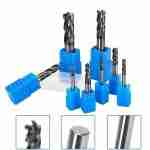
⑤ Solid Carbide Tool Blanks (End Mills / Drills / Reamers)
The YK35SF’s dense, uniform microstructure — porosity ≤ A02B00 per ISO 4505 — produces consistent grindability across production batches. Batch-to-batch hardness variation of ≤ 0.3 HRA is a standard delivery commitment. Ready to grind into solid carbide end mills, precision drills, or carbide reamers with consistent results.
5. Common Dimensions & Ordering Options
| Diameter (mm) | Standard Lengths (mm) | Coolant Hole | Typical Tool Type | Application |
|---|---|---|---|---|
| Φ3 – Φ6 | 100 / 200 | Optional | Micro end mills, PCB drills, engravers | Electronics, 3C precision parts |
| Φ4 – Φ12 | 200 / 330 | Optional | Solid carbide end mills, reamers | Hardened steel, aluminum finishing |
| Φ8 – Φ20 | 200 / 330 | Standard | Drills, boring bars | Graphite electrodes, composites |
| Φ6 – Φ32 | 200 / 330 | Custom | Tool shanks, die components | Stainless steel, titanium alloys |
Tolerance & Surface Specifications:
- Ground OD tolerance: h6 standard; h5 on request
- Surface condition: as-sintered or precision ground (Ra ≤ 0.2 μm)
- Coolant hole: straight bore or helical — specify bore diameter and helix angle at orderNeed a configuration not listed? We support fully custom geometries.
View our non-standard and custom carbide manufacturing capabilities →
6. Quality Evidence Package
Every batch of YK35SF cemented carbide rods ships with the following documentation as standard — not on request, as standard:
- ✅ Material Certificate of Conformance (CoC): WC%, Co%, density, HRA, TRS — batch traceable
- ✅ Hardness Test Report: HRA + HV30, full batch data, instrument calibration record included
- ✅ SEM Micrograph (10,000×): Grain uniformity confirmed; η-phase and free carbon verified at batch level
- ✅ Porosity Classification: Per ISO 4505 / GB/T 3489, rated ≤ A02B00
- ✅ Fracture Toughness Report (K_IC): ≥ 10 MPa·m¹/² by four-point bending method, accredited third-party laboratory
- ✅ RoHS / Conflict Minerals Declaration: Available for medical, aerospace, defense, and electronics customers
7. FAQ
What is the difference between 9%, 6%, and 12% cobalt carbide rods — and how do I choose?
9% Co is the balanced grade for most finishing applications — harder than 12% Co, tougher than 6% Co, and the most common substrate choice for precision cutting tools.
What cutting tools is a 0.4 μm ultrafine grain carbide rod best suited for?
Best for precision tools where edge sharpness and surface finish consistency are the primary criteria — solid carbide end mills, micro drills, reamers, and engraving tools.
Grain size directly limits how fine a ground edge is achievable after cylindrical grinding. At 0.4 μm, the edge radius after grinding is measurably finer than a 0.8–1.0 μm grade produces — meaning lower cutting forces, less BUE tendency, and better Ra on the workpiece.
How do I purchase carbide rod blanks — standard sizes or custom?
Standard sizes (Φ3–Φ32 mm, lengths 100/200/330 mm) are stocked for 3–5 business day shipment. Custom configurations are fully supported at 15–25 business days.
Custom options include non-standard diameters, special lengths, coolant holes (straight or helical — provide bore diameter and helix angle), tighter tolerances (h5), and precision ground surface finish.
8. Request a Quote — YK35SF Carbide Rod
Our technical team responds within 1 business day.
Request a Quote for YK35SF Ultrafine Cemented Carbide Rod — Response Within 1 Business Day →
— Cemented carbide manufacturer since 1966. From powder to precision-ground stock.
ISO 9001 · ISO 14001 · ISO 45001 certified · 270,000 m² facility · Walter / ANCA / Rollomatic grinding centers


Request a Quote for Carbide Tools