4 Flute Straight Shank Flat End Mill — Cut Harder. Last Longer.
Carbide End Mills | JYC Carbide Factory-Direct | ISO 9001:2015 Certified
1. The Right End Mill for Demanding CNC Applications
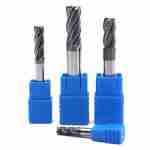
Our 4 Flute Straight Shank Flat End Mill is built for high-demand applications: steel profiling, cavity sidewall finishing, and high-volume production runs where consistent feed performance is non-negotiable. Browse our full range of solid carbide end mills for steel and hardened alloys to find the right geometry for your setup.

Every tool we ship is fully traceable from raw material intake through PVD coating, backed by JYC Carbide’s ISO-certified manufacturing process. Each batch ships with a Certificate of Conformance (COC). Custom geometries and OEM branding are available.
2. Typical Applications by Industry
| Industry | Typical Operations | Materials | Key Challenge |
|---|---|---|---|
| Automotive | Side milling, face milling of gearbox housings | 1045 steel, alloy steel, gray cast iron | High-volume consistency; tool life directly impacts cycle time |
| Mold & Die | Cavity profiling, step surface finishing | P20, H13, NAK80 | Wide hardness range (HRC 28–68); tool versatility is critical |
| CNC Job Shop | Slotting, contouring, face milling | 304 stainless, carbon steel | Work hardening in stainless accelerates tool wear |
| Aerospace | Structural contouring, precision mating surfaces | Ti-6Al-4V | Poor thermal conductivity concentrates heat at cutting edge; Vc must be controlled |
| Aerospace | High-temp component machining | Inconel 718 | Severe work hardening; requires low Vc and high coolant pressure |
| Medical | Implant profiling | 316L stainless, pure titanium | Ra and contamination specs are unforgiving |
| Industrial Machinery | Bracket and flange milling | Carbon steel, alloy steel | Interrupted cuts demand toughness over pure hardness |
Our 4 Flute End Mill for steel excels across these materials. Four-flute geometry increases radial rigidity, suppresses deflection, and eliminates chatter-induced surface waviness. All dimensions conform to DIN 6527 / ISO 1832 standards. For a closer look at tooling strategies in hardened cavities, see our guide on machining heat-treated mold steels up to HRC68.
3. Common Failure Modes — and How to Avoid Them
Most tooling failures aren’t random. Here’s what actually causes them:
- Premature chipping
Root cause: Cutting speed exceeds the material’s recommended Vc, or the carbide grade lacks sufficient toughness. When machining HRC 40–45 hardened steel, keep Vc at 60–80 m/min and axial depth of cut (ap) ≤ 0.3×D. Never run full-slot engagement on hardened material. - Poor surface finish (Ra out of spec)
Root cause: Using a 2-flute end mill on steel, or insufficient edge prep. Switch to a 4-flute geometry and verify tool runout is within spec — this alone eliminates most chatter marks. - Inconsistent tool life batch-to-batch
Root cause: Distributors can’t trace raw material sources. Different batches may use different carbide grades. Always request a COC with cobalt content and grain size data before committing to volume orders. - Coating delamination
Root cause: Low-adhesion PVD coatings fail above 600°C. Quality TiAlN coatings maintain performance to 800°C+. Ask your supplier for coating process specs, not just product names. - Dimensional drift (tolerance creep)
Root cause: Excessive tool runout shifts your finished dimensions. For precision mold and medical applications, use toolholders with runout ≤ 0.03mm (DIN 6535 high-precision grade). For general CNC work, ≤ 0.05mm is sufficient.
Using a Carbide 4 Flute Square Straight Flute end mill with the right parameters solves most of these issues. First-time setup tip: Start at 70% of recommended parameters. Check chip formation and vibration before stepping up feed rate.
4. Recommended Tool Combinations
✅ Steel Finishing Package (Carbon/alloy steel, up to HRC 45)
- Primary: 4 Flute Straight Shank Flat End Mill — TiAlN coating, 35° helix
- Support tools: Coolant-through solid carbide drill bits (pre-drilling) + 3-flute roughing end mill
- Coating rationale: TiAlN withstands cutting temps to 800°C — suited for dry cutting or MQL setups
✅ Mold & Die Package (P20 / H13 / DC53 / SKD11, HRC 28–68)
- Primary: Long-reach carbide end mill, L/D ≥ 3, TiAlN coating
- Support tools: Ball nose end mill (freeform finishing) + corner radius end mill (blend radii)
- Setup note: When L/D exceeds 4, reduce feed by 20–30% to prevent lateral deflection. For HRC 60+ work, use toolholders with runout ≤ 0.03mm.
✅ Titanium & Superalloy Package (Ti-6Al-4V / Inconel 718)
- Primary: Precision Carbide Endmills — AlTiN or TiSiN coating, 45° helix
- Support tools: Coolant-through drill (high-pressure) + hard-coated thread mill
- Coating rationale: AlTiN and TiSiN resist diffusion wear in titanium better than AlCrN. For Inconel, keep Vc at 20–40 m/min and use flood coolant. See our aerospace-grade carbide end mill applications for parameter references.
👉 Browse Full Carbide End Mills Catalog | 👉 Submit Custom Tooling RFQ
5. Carbide End Mill Performance Benchmarks
Based on customer feedback and internal testing. Results vary by machine, setup, and material. Confirm target specs with our engineers via RFQ before volume commitment.
- ⚡ ~25–35% increase in material removal rate — fewer tool changes per shift (automotive application vs. same-price domestic tooling)
- 🎯 Surface finish to Ra 0.8μm or better — verified in mold cavity and precision mating surface applications
- 🔁 40–60% longer tool life — internal comparison on P20 side milling; results vary by application
- ✅ Reduced scrap rate — tighter dimensional consistency across batch runs; contact us for application-specific data
- 💰 Lower total tooling cost — factory-direct pricing eliminates distributor margin; savings depend on your current supply chain
6. FAQ
What is a 4 Flute Straight Shank Flat End Mill used for?
It’s the go-to tool for milling steel, stainless steel, alloy steel, and cast iron — face milling, side milling, slotting, and profiling. Used across automotive, mold and die, aerospace, and general CNC machining. All tools conform to DIN 6527 / ISO 1832 dimensional standards.
What is the difference between 2-flute and 4-flute end mills?
Two-flute end mills have larger flute valleys — ideal for aluminum and soft materials where chip evacuation matters. Aluminum’s natural affinity for carbide causes built-up edge (BUE) with tight flute spacing. Four-flute end mills are stiffer, feed faster, and produce better surface finishes in steel. Don’t use a 4-flute on aluminum — chips will weld to the cutting edge.
How do I choose the right 4-flute flat end mill for my application?
Five factors drive the right selection:
① Material hardness (HRC) → determines carbide grade and cobalt content
② Operation type (roughing / finishing / slotting) → determines flute length and geometry
③ Spindle power and RPM → determines diameter range
④ Coating: TiAlN for dry steel cutting; AlTiN or TiSiN for titanium and superalloys; AlCrN for dry cutting of hardened steels
⑤ Precision requirements: Mold/medical work needs toolholder runout ≤ 0.03mm; general CNC ≤ 0.05mm is fine
Not sure? Send us your workpiece material, operation, and machine specs — our engineers will recommend the right tool at no charge.
7. Get Your 4 Flute End Mill Quote in 24 Hours
Tell us what you’re machining. We’ll respond within one business day.
- Tool type: 4 Flute Straight Shank Flat End Mill
- Diameter range needed (inch or mm)
- Workpiece material and hardness (HRC)
- Operation: roughing / finishing / slotting
- Quantity: samples or production run
- OEM branding or custom geometry needed?
- Ship-to location: United States
👉 Submit RFQ | 📧 info@carbide-factory.com
🏭 JYC Carbide — ISO 9001:2015 certified carbide tooling manufacturer. Standard items ship in 3–7 business days. Custom lead times quoted on request. COC included with every shipment. OEM and small-batch orders welcome.


Request a Quote for Carbide Tools