Carbide End Mill for Wood — Cut Cleaner, Last Longer
If your CNC machine is cutting wood, your tool choice almost entirely determines the outcome of every pass. A carbide end mill for wood isn’t just a regular end mill with a “woodworking” label — it’s a purpose-engineered tool designed for wood fiber structure, chip evacuation, and surface quality demands that metal-cutting tools simply aren’t built for. Getting the right carbide end mill for wood means cleaner edges, fewer scrapped parts, and a machine that finally runs the way it should.
Substrate selection, helix direction (upcut / downcut / compression), flute count, and chip clearance design collectively determine surface quality, tearout risk, and tool life. Every product in our solid carbide end mills range is developed against real woodworking production conditions — covering everything from high-volume furniture manufacturing to custom Job Shop operations.

What Is a Carbide End Mill for Wood?
A carbide end mill for wood is a solid end mill built on an ultrafine-grain tungsten carbide (WC-Co) substrate, purpose-designed for milling wood and wood-like materials. Compared to metal-cutting end mills, wood-specific tools feature several targeted design differences:
Sharper Cutting Edge Geometry for Clean Fiber Shearing
Wood is an anisotropic fiber structure. The angle between fiber direction and cut direction directly affects cut quality. Wood-specific carbide end mills use a higher rake angle, shearing wood fibers rather than crushing them — significantly reducing tearout and fraying on both cut faces.
Helix Direction: The Variable That Changes Everything
Upcut design evacuates chips upward — ideal for through-slot cutting but prone to top-surface tearout. Downcut design forces chips downward, delivering a clean top surface but poor chip evacuation. Compression design combines opposing helix directions on upper and lower cutting sections, simultaneously pressing fibers inward on both faces — the top choice for double-sided veneered panels. Our dual helix composite woodworking end mill is purpose-built around exactly this compression principle.
Coating and Substrate Balanced for Abrasion Resistance
MDF and engineered boards contain highly abrasive resins and adhesives that wear tools far faster than solid wood. A quality solid carbide end mill wood paired with the right coating maintains sharpness while effectively resisting wear across extended production runs.
1–3 Flute Design for Maximum Chip Clearance
Unlike metal cutting where 4-flute tools are common, woodworking end mills favor fewer flutes to provide larger chip clearance space — preventing chip packing and the heat buildup that leads to burning.
Wood End Mill Types: Full Product Range
Our end mills for woodworking series is organized by cutting direction and functional application:
Upcut Spiral End Mill — Best for Aggressive Material Removal
Chips evacuate upward, keeping the spindle area and spoilboard clean. Best for large stock removal and through-slot roughing. Trade-off: potential fine fiber fraying on the top surface. Suitable for operations that will be sanded afterward, or where bottom-face quality is not critical.
Downcut Spiral End Mill — Best for Top-Surface Finish
Chips are pressed downward. Top-surface fibers are pushed inward rather than pulled out, producing an exceptionally clean top edge. Ideal for single-face veneered panels, sign engraving, and decorative routing. Not suited for deep slot work; cutting depth must be controlled.
Compression End Mill — Best for Double-Sided Veneered Board
Upper section downcut + lower section upcut — simultaneously compresses fibers on both top and bottom faces. A single pass delivers clean, tearout-free edges on both faces. The standard choice for furniture factories and cabinet shops running laminated or veneered sheet goods.
Ball Nose End Mill — Best for 3D Profiling and Curved Surfaces
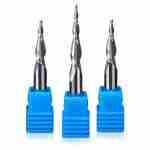
Used for wood 3D profiling, sculpted surface carving, and radius transitions. Widely used in furniture carving, decorative woodworking, and CNC guitar body contouring. Our woodworking ball nose long shank end mill is specifically engineered for deep cavity carving and extended-reach curved surface work. Combined with fine stepover settings, near-mirror surface finish quality is achievable.
Single Flute End Mill — Best for High-Speed Soft Material Cutting
Maximum chip clearance for high-speed cutting of softwood, MDF, and low-density materials. Single-flute geometry maintains clean chip evacuation at high spindle speeds, minimizing re-cutting and heat accumulation.
O-Flute End Mill — Best for Soft Wood and Mixed Materials
O-shaped cutting geometry specifically designed for softwood, foam-core wood, and wood-like composites. Smooth chip flow, low cutting resistance, and strong performance in mixed acrylic-and-wood applications. For decorative contouring and radius work on wood surfaces, our ball nose router bit for wood delivers consistent surface quality across a wide range of species and panel types.
CNC Woodworking Applications: Who Needs These Tools?
Cabinet & Furniture Manufacturing — High-Volume Panel Cutting
This is the largest single market for CNC end mill for wood. Precision cutting of 18mm+ veneered plywood, door frame side milling, and hinge pocket routing all require clean edges on both faces. Compression end mills are effectively standard equipment here. Core KPIs: tool change frequency, tooling cost per panel, and surface rework rate.
Sign Making & Display — Clean Edge Detail Work
Engraving and contour cutting of high-density PVC, MDF substrate, and solid wood signs demand clean edges and crisp detail — no fraying or chipping allowed. Downcut end mills and ball nose mills are the primary tools in this application.
Lutherie & Musical Instrument Manufacturing — Precision Hardwood Profiling
CNC profiling of guitar bodies, ukulele tops, and wooden necks demands high surface quality on hard species — maple, mahogany, Sitka spruce. Ball nose end mills combined with high spindle speeds and fine stepover are the standard approach to achieving fine surface finish on sculpted contours.
Custom Woodworking Job Shops — Versatility Across Multiple Materials
American Job Shop operations typically run solid wood, MDF, plywood, and OSB simultaneously in small batches with frequent job changes. A versatile, reliable wood end mill that covers the majority of daily operations without constant tool changes is the primary need. For shops that also cut metal alongside wood, our general machining solutions page covers compatible tooling for mixed-material environments.
Architectural Millwork & Retail Fixtures — Consistent Long-Run Edge Quality
Decorative moldings, trade show structures, and retail display fixtures require consistent edge quality across long workpiece runs, placing high demands on tool life stability throughout a production shift.
School & Maker Space CNC — Accessible, Reliable Entry-Level Cutting
Desktop CNC routers (Shapeoko, X-Carve, Onefinity) paired with solid carbide end mill wood for cutting pine, birch plywood, and MDF represent a high-frequency use case across the US DIY community and STEM education sector.
Key Specifications for Solid Carbide End Mills
⚠️ Note: The following is a general parameter framework. Specific values vary by product series and custom specification. Please share your requirements and our engineer will provide a complete parameter sheet.
| Parameter Field | Description | Note |
|---|---|---|
| Substrate | Ultrafine grain tungsten carbide (WC-Co) | Specific grade confirmed at RFQ |
| Number of Flutes | 1 / 2 / 3 flutes | Selected by material and feed rate |
| Helix Direction | Upcut / Downcut / Compression | Selected by surface quality requirement |
| Diameter Range | Please submit specification | Confirmed at RFQ stage |
| Flute Length | Short / Standard / Long | Based on required depth of cut |
| Shank Diameter | 1/4″ / 1/2″ / 6mm / 8mm / 12mm | Based on machine collet spec |
| Coating | Uncoated / TiAlN / DLC | Consult engineer by application |
| Applicable Materials | Solid wood / MDF / Plywood / Bamboo / Acrylic | Specify workpiece material in RFQ |
| Cut Direction | Climb / Conventional | Based on machine rigidity and surface need |
📩 Send us your specs — get a quote within 24 hours.
Why Upgrade to Tungsten Carbide Tools for Wood?
Longer Tool Life — Especially on MDF and Engineered Board
MDF resins and abrasives wear HSS tools at an aggressive rate. Tungsten carbide tools are significantly harder and more wear-resistant, allowing fewer tool changes for the same volume of work. Actual tool life varies by parameters and material — sample test data is the best benchmark.
Cleaner Cut Edges — Less Sanding, Lower Labor Cost
Sharp carbide cutting edges combined with the right helix selection dramatically reduce wood fiber tearout. For cabinet shops and sign shops, eliminating one sanding step directly reduces labor cost per part.
Higher Feed Rates Without Sacrificing Surface Quality
The higher rigidity of carbide tooling allows feed rates to increase without compromising surface finish, improving overall throughput. Verify actual parameters on your specific machine, as rigidity varies considerably between setups.
More Predictable Batch Consistency
The wear curve of quality solid carbide tooling is far more predictable than HSS, making it easier to establish a standardized tool change interval — which directly reduces batch-to-batch variation.
Competitive Pricing vs. Major US Brands
Brands like Amana Tool, Harvey Tool, and Whiteside are well known in the US market. We supply carbide end mills of equivalent quality at a more competitive price point — particularly suited to factories and distributors with volume purchasing needs. Sample test cuts are the definitive quality comparison. For OEM branding or non-standard geometry requirements, our custom non-standard carbide tool manufacturing program covers fully bespoke solutions built to your drawing.
Common Mistakes When Using a Wood End Mill — and How to Avoid Them
Using a Metal-Cutting End Mill on Wood
Metal-cutting end mills are designed for metal geometry. Wrong helix angles, inadequate chip clearance, and poor heat dissipation lead to burning, surface tearing, and rapid wear on wood. Always use a dedicated wood-specific tool.
Using a Downcut End Mill for Deep Slot Work
Downcut chips travel downward and pile up at the bottom of deep slots — trapping heat and causing re-cutting. Use an upcut end mill for deep slots, with multiple passes no deeper than 1–1.5× tool diameter.
Running Feed Rate Too Slow
Insufficient feed rate causes the tool to rub rather than cut, generating heat that accelerates edge wear and burns the workpiece surface. Chip load must meet the minimum recommended value for true cutting action.
Mismatched Spindle Speed and Feed Rate
Desktop routers and industrial CNC routers operate in very different RPM ranges, requiring different chip load targets. Tell us your machine type at RFQ stage and we can assist with parameter guidance.
Running MDF Without Establishing a Tool Change Interval
MDF wears tools several times faster than solid wood. Waiting until visible chipping appears before changing tools means significant scrap has already been produced. Build regular edge inspection into your workflow.
Ignoring Workpiece Fixturing
Even the best tooling cannot deliver consistent edge quality if the workpiece vibrates or shifts during cutting. Vacuum tables, clamps, and double-sided tape each suit different workpiece geometries. Poor workholding is the real cause behind many “bad tool quality” complaints.
FAQ — Carbide End Mill for Wood
Can you use an end mill on wood?
Yes. A dedicated carbide end mill for wood uses sharper angles and larger flute spacing designed for wood fiber — delivering cleaner cuts, less tearing, and longer tool life than metal-cutting end mills.
What is the best end mill material for woodworking?
Solid tungsten carbide is the top choice for production woodworking. It outlasts HSS significantly, especially in MDF and engineered boards. For extreme abrasion, diamond-coated options are available on request.
How to choose an end mill for hardwood?
For hardwood, use a 2–3 flute solid carbide upcut or compression end mill. Keep overhang under 4× diameter, maintain proper chip load, and confirm spindle RPM range matches the tool spec. Contact us for specific recommendations.
Ready to Order? Tell Us What You’re Cutting
From high-throughput batch panel cutting in furniture factories to small-run custom carving in Maker Spaces, our range covers standard catalog specs through to fully custom orders. Learn more about our manufacturing capabilities and quality certifications on our factory advantage and about us page.
Quick RFQ Checklist — respond within 24 hours:
- Workpiece material (wood species / MDF / plywood / other)
- Machine type (desktop CNC router / industrial router / machining center)
- Spindle interface / collet size (1/4″ / 1/2″ / ER collet / other)
- Tool type needed (upcut / downcut / compression / ball nose)
- Diameter and flute length requirements
- Volume requirements (per-order quantity / monthly usage)
- 📩 Talk to Our Engineer — Request a Quote or Send Drawing → You don’t need all the answers upfront — just tell us what you’re cutting and what problem you’re running into. Our engineers will handle the rest.
We — Professional tungsten carbide tools manufacturer | Carbide End Mills for Wood & Precision Woodworking Applications


Request a Quote for Carbide Tools