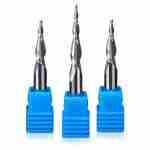
Long Reach Solid Carbide End Mill Description
Long Reach Solid Carbide End Mill is built for deep pocket side milling, step machining, and slotting operations where standard-length tools cannot reach the cutting zone without spindle or fixture interference. This Long Reach Solid Carbide End Mill holds a diameter tolerance of 0/-0.020mm under 12mm and 0/-0.030mm at 12mm and above, designed to maintain geometry consistency even under the increased deflection risk that comes with extended overhang. The TiAlN coating and helix angle above 45° target carbon steel, alloy steel, and prehardened / hardened steel up to 55HRC, with titanium alloy and heat-resistant alloy machining as validated secondary applications common in aerospace bracket and structural component work.
Long Reach Solid Carbide End Mill Details

- Shank Dia (mm):6mm 8mm 10mm 12mm 14mm 16mm 20mm
- Flute Dia.(mm):3mm – 20mm
- Cutting Length (mm):12mm – 55mm
- Overall Length (mm):75mm – 150mm
- Flutes:4 Flutes
- HRC:HRC 45 / 50 / 55
- MOQ:1 pcs (standard) / 1-50 pc (custom)
- Quality Standards: DIN 6537 and DIN 6535-HA
| Brand | JYC Carbide |
| Model NO. | Long Reach Solid Carbide End Mill |
| Product Item No. | JYC-NCP-4EL-D3-20 |
| Material | Tungsten Carbide (WC-Co) |
| Material Cobalt Content | Available for 6%-12% Usually 10%,12% |
| Material Hardness HV30 | Available 1660-2000 Usually 1660, 1700, 1780 |
| Grade | YG6 / YG8 / YL10.2/YK20UF/YK25UF/YK30SF |
| Coating | TiAIXN |
| Grain Size | 0.2-1.0um Usually 0.4um, 0.5um ,0.7um |
| Density | 14.2-14.90 g/cm3, usually 14.2g/cm3, 14.5g/cm3 |
| Tooth Form | Spiral Tooth |
| Tooth Space | Sparse Tooth |
| Inspection Type for Finished Products: | 100% inspection (Visual inspection & Function inspection) |
| Traceability of Raw Materials: | Yes |
| Tolerance | h6 |
| Customization: | Available |
| Laser Logo | Available |
| MOQ | 1 pcs (standard) / 1-50 pc (custom) |
| Lead Time | 3–5 days (standard) / 7–30 days (custom) |
| Certification | ISO 9001 / ISO 14001 / ISO 45001 / ISO 50001 / COC |
| Custom Service | OEM / ODM accepted |
Products Pictures


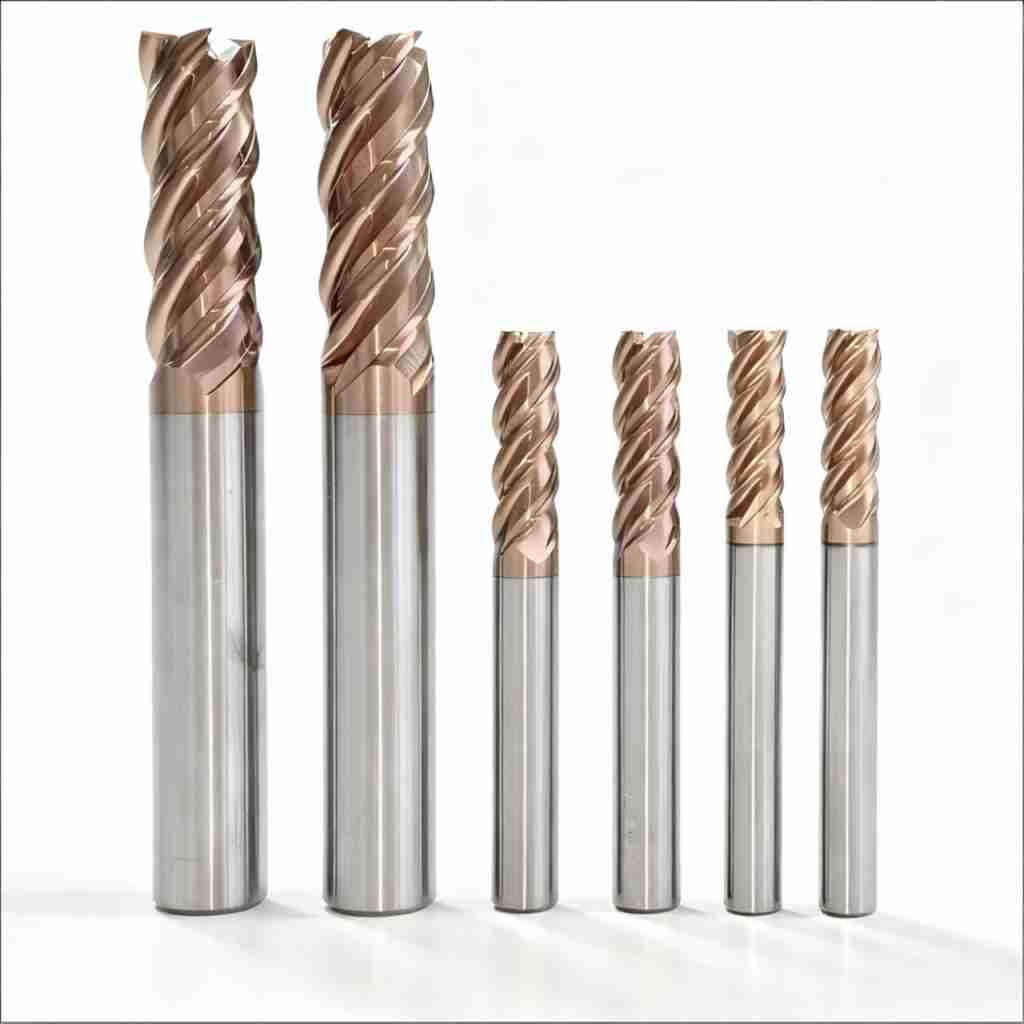
Available Size:
| NO. | Order Product No. | Size (mm) | Flutes (Z) | |||
|---|---|---|---|---|---|---|
| D | Handle D. | Cutting Length | Total Length | |||
| 1 | JYC-NCP-4EL-D3.0 | 3 | 6 | 12 | 75 | 4 |
| 2 | JYC-NCP-4EL-D4.0 | 4 | 6 | 15 | 75 | 4 |
| 3 | JYC-NCP-4EL-D5.0 | 5 | 6 | 20 | 75 | 4 |
| 4 | JYC-NCP-4EL-D6.0 | 6 | 6 | 20 | 75 | 4 |
| 5 | JYC-NCP-4EL-D8.0 | 8 | 8 | 25 | 100 | 4 |
| 6 | JYC-NCP-4EL-D10.0 | 10 | 10 | 30 | 100 | 4 |
| 7 | JYC-NCP-4EL-D12.0 | 12 | 12 | 35 | 100 | 4 |
| 8 | JYC-NCP-4EL-D14.0 | 14 | 14 | 40 | 100 | 4 |
| 9 | JYC-NCP-4EL-D16.0 | 16 | 16 | 50 | 150 | 4 |
| 10 | JYC-NCP-4EL-D20.0 | 20 | 20 | 55 | 150 | 4 |
* Non-standard sizes available upon request. Contact us for custom specifications,We will feedback to you within 24 Hours.
Applicability for Materials
◎ = Perfect for ○ = Suit — = N/A
| Carbon Steel | Alloy Steel | Pre-hardened Steel / Hardened Steel | Stainless Steel | Cast Iron / Nodular Cast Iron | Copper Alloy | Aluminium Alloy | Titanium Alloy | Heat-resistant Alloy | |||
|---|---|---|---|---|---|---|---|---|---|---|---|
| ~45HRC | ~50HRC | ~55HRC | ~68HRC | ||||||||
| ◎ | ◎ | ◎ | ◎ | ◎ | — | ○ | ◎ | — | — | ○ | ○ |
Long Reach Solid Carbide 4 Flute Square End Mill: Product Overview
For an aerospace parts shop machining aerospace machining titanium brackets or hardened steel structural components, tool failure rarely announces itself with a warning — it shows up as chipped edges or chatter marks discovered mid-batch. Understanding why these failures happen, rather than just replacing the tool and hoping for a better outcome, is what separates a one-time fix from a repeatable process.
Failure Case One: Edge Chipping During Long Reach Titanium Milling
An aerospace parts shop machining Ti-6Al-4V structural brackets on a 5-axis mill reported edge chipping on a long reach end mill within the first 8-10 parts of a batch, well short of the tool life the shop had budgeted for the job. The chipping consistently appeared on the same flute position, not randomly distributed across the cutting edge.
The root cause traced back to titanium’s low thermal conductivity, which is roughly one-seventh that of steel, meaning heat generated at the cutting edge does not dissipate into the chip or workpiece efficiently and instead concentrates at the tool tip. This is a well-documented challenge specific to carbide end mills for titanium applications, where combined with a long reach tool’s inherent flexibility, this concentrated heat softened the coating locally at the exact point where tool deflection was already placing the highest stress, creating a compounding failure mode rather than a single cause.
Solution: Radial Engagement and Coating Match
The solution involved two changes rather than one: first, reducing radial depth of cut to roughly 30% of tool radius, a documented approach for controlling heat generation specifically in titanium milling since it limits how much cutting edge is engaged at once; second, confirming the tool’s helix angle and TiAlN coating were matched to titanium’s thermal profile rather than assuming a general-purpose hardened-steel geometry would perform identically on titanium.
Chipping stopped once radial engagement was reduced and coolant delivery was verified to reach the actual cutting zone rather than just the tool shank — a diagnostic step covered in more detail in our guide on coolant through solid carbide drills, since the same delivery-verification logic applies to end mills operating in deep, hard-to-reach pockets. Shops that treat coolant delivery as a checkbox rather than a verified variable tend to see this same chipping pattern recur across multiple batches until the actual flow path is confirmed.
Failure Case Two: Chatter and Vibration on Long Reach Deep Pocket Work
A second recurring issue reported by shops running long reach end mill tooling on deep aerospace pocket features is chatter and out-of-tolerance surface finish, particularly on cuts requiring 4-5 inches of tool overhang. Unlike the chipping case above, this failure mode shows up as a visible finish defect and audible vibration rather than sudden edge failure.
Tool deflection increases with the cube of overhang length, as documented in machining engineering references on beam deflection principles, meaning a small increase in stickout produces a disproportionately large increase in tool flex under cutting load. Shops chasing this problem by only adjusting spindle speed or feed rate often see partial improvement but not resolution, because speed and feed changes address the symptom of chatter without addressing the underlying rigidity deficit.
Solution: Minimizing Overhang and Radial Engagement
The consistent fix across documented cases is to minimize overhang to the shortest length that still clears the pocket depth, since shorter overhang is the single highest-leverage variable for reducing deflection and chatter in long reach tooling. Where the application allows a corner radius rather than a sharp square profile, switching to a long reach corner radius carbide end mill can also reduce stress concentration at the cutting edge, which is a relevant alternative geometry worth evaluating alongside overhang reduction. Where overhang cannot be reduced further due to part geometry, reducing radial engagement to roughly 20-30% and verifying tool holder runout are the next most effective levers, rather than defaulting to a slower spindle speed which can sometimes cause rubbing instead of resolving vibration.
Design Features of This Long Reach Carbide End Mill for Aerospace Machining
The 45°+ helix angle on this tool directly addresses the chatter failure mode: a higher helix angle increases the effective shearing action at the cutting edge, which reduces radial cutting force — the force component most responsible for tool deflection and chatter in long reach applications. Lower radial force means less deflection at a given overhang length compared to a lower-helix design cutting the same material.
The TiAlN coating’s oxidation resistance up to approximately 800°C at the cutting edge, based on general carbide coating industry data, addresses the chipping failure mode by maintaining coating integrity through the elevated, concentrated heat generation characteristic of machining hardened steel and titanium. This does not eliminate the need for correct radial engagement and coolant delivery, but it provides margin against coating breakdown that a lower-temperature-rated coating would not offer under the same thermal load. For shops looking to extend service life further within this design envelope, our guide on how to extend carbide end mill life covers additional handling and setup factors beyond geometry and coating selection.
Where to Buy This Long Reach Solid Carbide End Mill
Once a failure pattern is correctly diagnosed and the geometry-material match is confirmed, the remaining question for a purchasing engineer is sourcing. Shops evaluating a long reach carbide end mill supplier typically check three things: whether sample batches are available for validation before committing to volume, whether material traceability documentation accompanies the order, and whether consistent stock levels support repeat quarterly orders without lead-time gaps.
For buyers new to sourcing tooling internationally, our guide on how to find a reliable carbide cutting tool supplier in China outlines the verification steps worth applying here, including factory audit documentation and sample-before-bulk validation. For shops sourcing in Carbide end mill Wholesale quantities to support multiple production lines, confirming diameter tolerance consistency across a bulk order matters as much as the unit price, since a batch with wider tolerance variation can introduce the same deflection and chatter issues described above even when using the correct helix and coating specification.
Specification Summary: DIN 6527 Long Reach Solid Carbide End Mill
Specific RPM, feed-per-tooth, and depth-of-cut values within each tier depend on tool diameter, machine power, and coolant method, and should be confirmed through small-batch trial cuts before scaling to full production volume. For broader context on how this fits within our full catalog, see the machining knowledge hub covering related end mill selection topics.
Packaging & Delivery
| Packaging | Individual plastic tube + foam box |
| Port | Shenzhen / Guangzhou /Shanghai |
| Lead Time | 3–5 days (in-stock) / 7–30 days (custom) |
| Shipping | DHL / FedEx / UPS / Sea freight |
FAQs
Q: Why does my long reach end mill chip specifically when machining titanium, but not on steel?
A: Titanium’s thermal conductivity is roughly one-seventh that of steel, so heat concentrates at the cutting edge instead of dissipating into the chip. Combined with the added deflection of a long reach tool, this concentrated heat can locally weaken the coating at the point of highest mechanical stress, producing chipping that wouldn’t occur under the same parameters on steel.
Q: What’s the single most effective way to reduce chatter on a long reach end mill in a deep pocket?
A: Minimizing overhang to the shortest length that still clears the pocket depth has the largest impact, since tool deflection increases with the cube of overhang length. Reducing radial engagement and verifying tool holder runout are the next most effective adjustments if overhang cannot be reduced further.
Q: Should I just slow down the spindle speed if I’m seeing vibration on a long reach tool?
A: Not as a first step. Slowing spindle speed without addressing overhang or radial engagement can sometimes cause rubbing rather than resolving chatter, since rubbing is a separate failure mode caused by running too slow for the actual chip load.
A VISIBLE QUALITY. YOU CAN BE TRUSTED.
01
Please confirm the tool size, coating type, and material compatibility before placing an order.
02
Carbide end mills are fragile – avoid impact and store them in a dry, secure place.
03
Ensure proper cutting parameters (speed, feed, depth) for best performance and tool life.
04
Wear safety protection (goggles, gloves) when operating cutting tools.
05
If you’re not sure which type to choose, feel free to contact us for professional recommendations.
Purchase Information
After-sales Support: We offer technical guidance and quick response for any product or usage concerns.
MOQ & Customization: Most models are in stock. Custom logo, size, or packaging is available – please consult before ordering.
Shipping: We support express, air, and sea shipping. Delivery time may vary by region and quantity.
Quality Assurance: All tools are inspected before shipment. We provide SGS and ISO certificates upon request.
Returns & Warranty: Defective or damaged products due to manufacturing issues can be replaced.
Shipping Terms
If you have any special requirements on packing, please contact us for shipping cost and lead time. See our general Shipping & Return Policy for details.
Long Reach Solid Carbide End Mill for Titanium Milling

Long reach solid carbide 4 flute end mill with TiAlN coating for titanium and hardened steel deep pocket milling. Aerospace grade, request sample testing.
Product SKU: JYC-NCP-4EL-D3-20
Product Brand: JYC Carbide
Product Currency: USD
Product Price: 5
Price Valid Until: 2036-12-12
Product In-Stock: InStock
4.89

Request a Quote for Carbide Tools