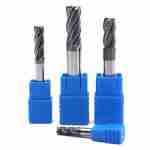
A 4-flute end mill offers higher core stiffness and more cutting edges per revolution than 2- or 3-flute designs, making it a practical choice for steel slotting and semi-finishing. This guide covers where 4-flute geometry excels, where it doesn’t, series selection by material, precision specifications, and what to verify before running deep slots.


For a broader overview of available geometries, see carbide end mills or the 4-flute straight shank flat end mill product page.
1. Core Advantages and Known Limitations
Why 4-Flute Works Well in Steel
Four-flute designs typically carry a core-to-diameter ratio of approximately 65–70%, which increases cross-sectional bending stiffness compared to 2- or 3-flute tools of the same diameter. In steel side milling and slotting, this translates to reduced deflection tendency and more stable cuts at moderate chip loads. More cutting edges per revolution also tends to produce lower surface roughness in semi-finishing passes versus 2-flute tools.
Where 4-Flute Falls Short
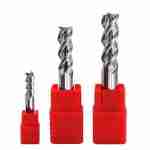
The narrower chip gullet is the main constraint. In aluminum full-slot cutting, chips cannot evacuate fast enough, leading to built-up edge (BUE), clogging, and accelerated tool wear. Standard 4-flute end mills are not recommended for aluminum slotting. For aluminum, JYC Carbide’s AU or AUR series (2–3 flute, high helix) are the correct choice.
Full-slot depth capability (ap) depends on machine rigidity, workpiece material and hardness, holder stickout, and coolant delivery — not on tool geometry alone. Starting at ap = 1×D in full slot (ae = D) and validating cutting conditions before increasing depth is the practical approach for most setups.
2. Material Range and Series Selection
Correct series selection follows workpiece material and hardness, not diameter alone.
| Material Group | Series | Hardness Range | Typical Grades |
|---|---|---|---|
| General steel | NCG | HRC≤45 | 45#, 40Cr, 42CrMo — structural parts and general slotting |
| Pre-hardened steel | NCP | HRC≤55 | P20, 718, NAK80 — mold bases, inserts |
| Hardened steel | NCH | HRC45–65 | SKD11, D2, H13 (hardened) — mold cavities, tooling |
| Stainless steel | NCPX | — | 304, 316, 17-4PH — full-slot ae should be reduced; confirm with engineering |
| Aluminum | AU / AUR | — | Not recommended for 4-flute; use AU/AUR 2–3 flute series |
For stainless steel applications with 304, 316, or 17-4PH, the stainless steel specific flat end mill (NCPX) is purpose-built for these grades. For hardened tool steel at HRC45–65, see hardened steel end mills (NCH series).
Titanium (TC4 / TC11) — Use With Caution
In full-slot conditions, standard 4-flute geometry limits chip evacuation in titanium. Two- or three-flute tools with unequal pitch are generally preferred. If a 4-flute is required, use an unequal-pitch variable-helix version with high-pressure coolant (≥30 bar where machine equipment supports it). Cutting parameters must be confirmed per workpiece condition at RFQ stage.
3. Typical Applications
4-flute end mills are commonly used in:
- Steel full slots, keyways, and step features at HRC≤55
- Mold insert ejector pin slots and cavity floor semi-finishing
- Structural part T-slots and formed grooves
- Aerospace steel frame rib slots (non-aluminum)
- Semi-finishing passes where lower surface roughness is needed compared to 2-flute roughing
For die and mold machining context, see die & mold applications. For hardened steel cavity work at HRC45–65, the hard material specific flat end mill (NCH) is the more appropriate geometry.
4. Precision Specifications (JYC Carbide Standard)
| Parameter | Tolerance | Reference Standard |
|---|---|---|
| Cutting diameter D ≤12 mm | 0 − 0.020 mm | — |
| Cutting diameter D >12 mm | 0 − 0.030 mm | — |
| Shank tolerance | h6 | ISO 286-1 |
| Runout TIR (D ≤12 mm) | ≤0.05 mm | — |
Sidewall straightness and floor flatness in the finished part are determined by machine spindle condition, holder runout, thermal expansion during cutting, and toolpath strategy — not by tool diameter tolerance alone. Applications with specific GD&T requirements should be confirmed with engineering at RFQ stage.
For shank tolerance definitions and the h5 vs h6 distinction, see the DIN 6537 and DIN 6535-HA standards reference.
5. Coating Reference by Material Group
- AlTiN / AlTiSiN: Steel and pre-hardened steel (NCG / NCP) — wear and heat resistance under dry or semi-dry conditions
- AlCrN / nACo: Hardened steel and stainless steel (NCH / NCPX) — oxidation resistance, reduced built-up edge tendency
Coating selection is not independent of substrate material, edge preparation, cutting heat, and coolant delivery. Do not select a coating based on name alone — confirm against your material and process conditions.
6. Practical Notes From Real Setups
- Do not use aluminum-geometry 4-flute tools on steel. The flute geometry is optimized for aluminum chip evacuation. On steel, you will see chatter and accelerated wear.
- Check stickout before adjusting cutting parameters. Most deep-slot chipping failures trace back to excessive holder stickout (>4×D), not tool grade. Reduce stickout first, then optimize fz and Vc.
- Start at ap = 1×D full slot and validate before increasing. Machine and fixture rigidity varies significantly. A starting parameter that works on a Makino VMC may not transfer to a lighter VMC without adjustment.
- Pre-hardened steel at HRC50+ requires higher coolant flow. Cutting heat concentrates at the cutting edge. Insufficient cooling accelerates coating delamination even when Vc is within range.
- Stainless steel full-slot is high-risk with standard 4-flute. 304 and 316 have strong BUE tendency in full-slot conditions. Use the NCPX stainless series and reduce ae to 0.5×D or less as a starting point.
7. Frequently Asked Questions
What is the maximum full-slot depth (ap) for a 4-flute end mill?
For steel at HRC≤45, ap = 1×D full slot (ae = D) is a reasonable starting point. Reaching ap = 1.5–2×D is achievable in setups with good machine rigidity, short stickout, adequate coolant, and reduced fz — but these parameters require trial cutting validation and cannot be applied universally. Always confirm with your specific machine and fixturing before committing to production.
Does a 4-flute end mill last longer than a 3-flute?
Not categorically. In semi-finishing and low-ae side milling, each flute carries a lower chip load per revolution, which can extend tool life. In full-slot conditions where chip evacuation is the limiting factor, a 4-flute may wear faster than a 3-flute if fz is not adjusted accordingly. Compare on your specific workpiece, not on theory alone.
How do I configure a 4-flute set for a new shop?
Configuration depends on your primary material groups and machining stages. The carbide end mill set selection guide covers configuration by application type and can help structure an initial inventory.
8. What to Confirm Before RFQ
- Workpiece material grade and actual measured hardness
- Machining operation: full slot, side milling, step, keyway, or T-slot
- Required cutting diameter, flute count, overall length, flute length, and actual stickout
- Machine type, spindle speed range, holder system (ER collet / hydraulic / shrink-fit), and coolant method
- Current issue: chipping, chatter, dimensional drift, surface finish not meeting drawing, or BUE
- Machining stage: roughing only, roughing to semi-finish, or post-hardening direct finish
9. Request a Specification
4-flute end mills are a reliable platform for steel slotting and semi-finishing — when matched to the correct material group, series, and cutting conditions. They are not a universal answer for all materials or all slot depths.
Submit your workpiece material, hardness, machining operation, machine model, holder system, stickout, and current issue. JYC Carbide will provide a series recommendation, starting parameter range, and shipment inspection report based on your RFQ. Sample policy, lead time, and non-standard requests are confirmed during inquiry.
We will provide application-specific recommendations based on your actual machining conditions — not generic starting parameters.
Certifications: ISO 9001 / 14001 / 45001 / 50001 / COC / SGS
Active customers: 1,200+ across 40+ countries
Pieces delivered: 40 million+



Request a Quote for Carbide Tools