What Is a Carbide End Mill Set
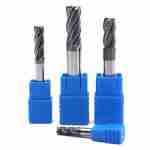
A carbide end mill set is a pre-configured collection of solid carbide end mills designed to address common milling operations without requiring individual tool purchases. These sets typically include 6-20 pieces covering multiple diameters, flute counts, and geometries suited for specific material groups or machining stages.
Typical Use Cases:
- Small to medium shops requiring immediate tooling capability
- Contract manufacturers handling diverse part geometries
- Training facilities teaching multi-stage milling processes
- Backup tooling inventory for high-mix production


Typical Set Configurations by Application
| Set Type | Tool Count | Typical Inclusion | Best For |
|---|---|---|---|
| General Purpose | 8-12 pcs | 2-4 flute flat end mills (Ø3-12mm), 2 flute ball nose (Ø6, Ø8mm) | Mild steel, aluminum, general machining |
| Aluminum Optimized | 6-10 pcs | 2-3 flute high helix (35-45°), uncoated polished finish | 6061, 7075 aluminum alloys, high MRR |
| Hard Material | 6-8 pcs | 4-6 flute, TiAlN coated, variable helix, Ø4-10mm | Hardened tool steel (HRC45-62), die and mold work |
| Finishing Set | 6-10 pcs | 4-6 flute, corner radius (R0.5-R2), ball nose, polished edge | Surface finish Ra0.4-1.6μm, contour work |
| Stainless Steel | 6-8 pcs | 4 flute, AlTiN coated, reinforced core, Ø6-12mm | 304, 316, 17-4PH stainless |
Material Compatibility & Recommended Tool Features
| Material Group | Hardness Range | Flute Count | Coating | Helix Angle |
|---|---|---|---|---|
| Aluminum Alloys | HB 60-95 | 2-3 flute | Uncoated (polished) | 40-45° |
| Mild Steel / P20 | HB 280-330 | 4 flute | TiAlN or TiCN | 35-38° |
| Stainless Steel | HB 160-240 | 4 flute | AlTiN | 35-38° |
| Hardened Tool Steel | HRC 45-62 | 4-6 flute | TiAlN or nACo | Variable helix |
| Cast Iron | HB 190-260 | 4 flute | TiCN or uncoated | 30-35° |
| Titanium Alloys | HRC 30-36 | 3-4 flute | AlTiN | 38-40° |
Note: These are general recommendations. For specific material grades (e.g., Inconel 718, Ti-6Al-4V) or high-hardness applications (HRC >58), consult our machining parameter database or request application support.
How to Choose the Right Carbide End Mill Set
Decision Factors
1. Primary Material Group
Match the set coating and geometry to your most frequent workpiece material. If you machine multiple material types, consider a general-purpose set with 4-flute tools and TiAlN coating, which provides acceptable performance across steel, stainless, and cast iron.
2. Diameter Range Requirements
Evaluate your typical part features:
• Small details (Ø3-6mm): Requires micro-diameter tools
• Standard pockets/slots (Ø6-12mm): Most common range
• Large facing operations (Ø12-20mm): Consider individual purchase for these sizes
3. Machining Stage Coverage
• Roughing-only sets: 2-3 flute, chip breaker geometry, ideal for high MRR
• Finishing-only sets: 6-flute, polished edge, for Ra <0.8μm
• Complete sets: Include both roughing and finishing tools (recommended for job shops)
4. Machine Tool Compatibility
Verify your machine’s spindle speed and rigidity:
• Manual mills / older CNCs (<8,000 RPM): Use larger diameter sets (Ø8-16mm)
• Modern CNCs (10,000-24,000 RPM): Can utilize full range Ø3-16mm
• High-speed machining centers (>30,000 RPM): Pair with small-diameter, high-helix aluminum sets
When NOT to Buy a Set:
• You machine only one material type consistently (buy optimized individual tools)
• You require specialized geometries (long reach, extra-long flute, tapered)
• Your volume justifies custom tool development
Usage Guidelines & Maintenance
Setup Requirements
- Tool Identification: Each tool in the set should have laser marking indicating diameter, flute count, and coating type. Verify markings match your machining plan before installation.
- Holder Selection: Use ER collet chucks or hydraulic holders to achieve runout <0.01mm. Avoid Jacobs-style drill chucks for carbide end mills.
- Coolant Strategy:
- Aluminum (uncoated tools): Flood coolant or air blast minimum
- Steel/stainless (coated tools): High-pressure through-spindle coolant (70+ bar) or MQL for shallow cuts
- Hard materials (HRC >45): Through-tool coolant mandatory for ap >0.5×D
Starting Parameters by Material
These are conservative starting points. Adjust based on machine rigidity, tool overhang, and part stability.
| Material | Vc (m/min) | fz (mm/tooth) | ap (×D) | ae (×D) |
|---|---|---|---|---|
| 6061 Aluminum | 250-400 | 0.08-0.15 | 1.0-1.5 | 0.4-0.5 |
| P20 Mold Steel | 120-180 | 0.05-0.10 | 0.5-1.0 | 0.1-0.3 |
| 304 Stainless | 80-120 | 0.04-0.08 | 0.3-0.5 | 0.1-0.2 |
| SKD11 (HRC58) | 60-100 | 0.03-0.06 | 0.2-0.3 | 0.05-0.1 |
Storage & Tool Life Management
- Store tools in the provided case with designated slots to prevent edge contact damage
- Apply thin rust-preventive oil after use, especially for uncoated tools
- Inspect cutting edges with 10× magnification after every 2-3 parts; retire tools showing coating delamination or edge rounding >0.02mm
- Document tool usage hours or part count to establish baseline life for reorder planning
Common Issues & Solutions
| Symptom | Likely Cause | Corrective Action |
|---|---|---|
| Premature chipping on coated tools | Excessive runout or interrupted cut entry | Check holder TIR; use ramp entry instead of plunge |
| Built-up edge on aluminum | Insufficient chip evacuation or low speed | Increase RPM, use flood coolant, verify 2-flute selection |
| Poor surface finish (Ra >1.6μm) | Wrong flute count for operation | Switch to 4-6 flute for finishing; reserve 2-3 flute for roughing |
| Tool deflection in deep pockets | Excessive overhang (L/D >4) | Reduce ae to 0.05-0.1×D; consider step-down strategy or long-reach specialized tools |
Frequently Asked Question
What’s the difference between a “general purpose” and “material-specific” end mill set?
General purpose sets use 4-flute geometry with TiAlN coating, providing acceptable (but not optimized) performance across multiple material groups. Material-specific sets match flute count, helix angle, and coating to one material family—for example, 2-flute high-helix uncoated for aluminum, or 6-flute variable helix TiAlN for hardened steel. If 70%+ of your work is in one material, choose a specific set. For job shops with diverse materials, start with general purpose.
How do I determine if my shop needs an 8-piece or 16-piece set?
Audit your last 20 jobs:
• 8-piece set: Sufficient if 80%+ of features use Ø6, Ø8, Ø10, Ø12mm, and you perform only one machining stage (e.g., roughing only, with finishing subcontracted)
• 12-16 piece set: Needed if you handle complete machining (rough to finish), require Ø3-4mm for small details, or machine thin walls needing multiple stepdown passes with different flute counts, For high-mix, low-volume shops, larger sets reduce tool changeover and eliminate “missing diameter” delays.
Can I mix tools from different sets or manufacturers?
Yes, but maintain consistent nomenclature and storage. The primary advantage of a factory set is diameter consistency (±0.005mm) and coating uniformity within one production batch. Mixing brands may introduce tolerance variation. If supplementing a set, request tools from the same substrate grade (e.g., YG10X, K40) to ensure similar wear behavior.
Q4: Are carbide end mill sets cost-effective compared to buying individual tools?
A: Sets typically offer 15-25% savings vs. individual tool list prices when purchasing 6+ pieces. However, cost-effectiveness depends on utilization:
• High value: Job shops, R&D labs, training facilities where all diameters see regular use
• Low value: Dedicated production lines machining one part number repeatedly (you’ll use only 1-2 diameters; buy those individually)
• Break-even analysis: If you use ≥50% of the set’s tools within 6 months, the set pricing is justified
Q5: What information do I need to provide for a custom set configuration?
A: To configure a custom set, send us:
1. Material grades you machine (with hardness if known)
2. Part feature types: Open pockets, full slots, contours, deep ribs, etc.
3. Diameter requirements: List the 6-12 most-used sizes
4. Machining stages: Roughing only, finishing only, or complete process
5. Machine specs: Max RPM, coolant type (flood/through-tool/MQL/air)
6. Annual volume estimate to determine if premium coating justifies cost
We’ll recommend flute counts, coatings, and optional features (corner radius, variable pitch, etc.) within 24 hours. See our custom tool development process for specialized requirements.
Q6: How should I organize and label a mixed set after receiving it?
A: Best practices for set management:
• Photograph the original case layout before first use
• Label each slot with: Diameter, Flute count, Coating, Material recommendation
• Create a usage log sheet tracking: Tool ID, Part number machined, Cutting time, Condition notes
• Segregate worn/damaged tools immediately to prevent accidental use
• Reorder individual tools as depleted rather than waiting for complete set depletion
For shops with multiple sets, consider color-coded cases: Blue for aluminum sets, red for steel sets, yellow for hard material sets.
Q7: Can end mill sets be resharpened, or are they disposable?
A: Solid carbide end mills can be resharpened 2-4 times depending on original geometry and wear extent. However:
• Coated tools: Resharpening removes coating; recoating adds cost. Economical only for Ø12mm+ tools
• Small diameters (≤Ø6mm): Resharpening cost often exceeds replacement cost
• Set economics: Most users treat set tools as disposable and reorder depleted diameters individually
If you machine hard materials (HRC >55) or high-value parts where tool cost is <5% of part value, resharpening larger diameters (Ø10mm+) may be worthwhile.
Q8: What’s the typical delivery time for standard vs. custom configured sets?
A: Delivery timelines:
• Standard catalog sets: 3-5 working days (stock items)
• Custom diameter selection (from standard tools): 5-7 working days
• Custom geometry/coating: 15-20 working days (requires production batch)
• International shipping: Add 5-10 working days depending on destination and customs clearance
For urgent requirements, inquire about expedited service availability. Minimum order quantities may apply for custom configurations.
Request Custom Configuration or Quote
For Engineers & Machinists:
Send us your typical part drawings or describe your machining challenges. Include:
• Material grade and hardness (e.g., “NAK80 at HRC40”, “304 stainless”)
• Machine tool spindle max RPM and coolant setup
• Feature types (pockets, slots, contours, ribs)
• Current tooling issues (chatter, poor finish, short life)
We’ll recommend a set configuration with starting parameters, tool selection logic, and application notes within 24 hours.
For Purchasing & Procurement:
Provide:
• Desired set size (6-pc, 10-pc, 16-pc, etc.)
• Diameter range preference
• Annual estimated consumption
• Delivery location and required lead time
We’ll provide:
• Itemized quotation with individual tool specs
• Volume discount tiers
• Delivery schedule
• Quality certifications and inspection reports upon request
Contact Options:
• Submit technical inquiry or request quote
• Response time: Within 24 hours on working days
Last updated: January 2026. Specifications and availability subject to change. All technical data provided as reference only; verify suitability for your specific application.



Request a Quote for Carbide Tools