Market Overview
Woodworking cutting tools are the core supporting products across the wood processing value chain, covering carbide-tipped (TCT) router bits, saw blades, drill bits, and profile cutters used in furniture manufacturing, construction and interior fit-out, and general wood processing. Tool precision, edge life, and surface finish quality directly determine downstream machining efficiency and part accuracy — this is why the sector sits at the center of the wood processing supply chain rather than at its edge.


Through 2026, three forces are reshaping the industry: continued upgrading of wood processing applications, tightening environmental compliance requirements, and broader adoption of automated production lines. Combined, these forces are pushing the market toward higher-end products, more refined manufacturing processes, and a wider range of end-use applications — a shift toward quality-driven growth rather than volume-driven growth.
On the demand side, growth remains steady but uneven by region. Domestic demand is supported by continued expansion of China’s wood processing sector, ongoing product mix upgrades, and pull-through demand from downstream furniture and construction industries. Export demand carries more uncertainty — tied to global economic conditions and geopolitical shifts — but international markets remain a meaningful growth opportunity for Chinese carbide tool manufacturers with the technical capability to compete on quality, not just price.
On the supply side, manufacturers are focused on three priorities: improving product quality, investing in R&D, and refining manufacturing processes. Leading manufacturers with strong technical depth, proven quality systems, and established supply chains continue to hold the dominant market position, while overall industry capacity keeps pace with the diversifying needs of downstream buyers.
Competitive Landscape
Market Structure and Positioning
Competition in China’s woodworking tools market is intense and structurally split into two distinct tiers, with overall market concentration sitting at a moderate level.
The first tier consists of manufacturers with scaled production capacity, strong R&D capability, and established brand recognition. These companies compete primarily in the mid-to-high end, holding dominant positions in CNC-compatible carbide tooling and cemented carbide (tungsten carbide) tool segments. Competition at this tier centers on technical innovation, dimensional accuracy, and service quality — not price. Buyers evaluating a new supplier relationship often start by learning how to find a reliable carbide cutting tool supplier before committing to a first order.
The second tier is made up of a large number of smaller manufacturers with limited technical capability and production scale. These companies compete mainly in the low-to-mid end, where product differentiation is minimal and price remains the primary competitive lever, leaving thin margins across the board.
This bifurcation has produced a clear structural pattern. At the high end, import dependency persists — core technology and premium products remain concentrated among European, American, and Japanese brands, while Chinese manufacturers are still working to close the technical gap and advance import substitution in carbide woodworking tools. At the low end, overcapacity is a persistent problem: many smaller manufacturers, lacking a defensible technical edge, remain locked into a low-margin, low-differentiation cycle that suppresses industry-wide profitability.
Looking ahead, consolidation pressure is expected to intensify. Outdated production capacity will continue to exit the market, and resources will concentrate further among leading manufacturers — a trend that should gradually raise overall market concentration.
Market Segmentation
Product Segments
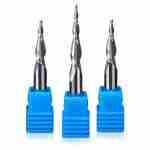
Product segmentation in the woodworking tools market is well-defined. Core products are dominated by specialized cutting tools — router bits, saw blades, drill bits, and profile knives — engineered for specific wood processing applications, alongside a smaller category of supporting accessories. Router bits and cutting tools account for the largest share of the market, spanning multiple sub-categories used across nearly every stage of wood processing.
Within this category, tool geometry matters as much as material grade. Shops cutting solid wood panels typically rely on downcut end mills for wood to keep the top surface clean and free of tear-out, while upcut end mills for wood remain the standard choice when fast chip evacuation matters more than surface finish. For deeper cuts and composite panels, many shops have shifted toward spiral end mills for wood, which balance chip removal with edge quality across both directions of the cut. Supporting accessories represent a smaller share of total volume but are growing quickly as downstream demand diversifies — making this a notable growth pocket within the broader category.


The product mix is shifting decisively upmarket. As furniture manufacturers and construction contractors raise their requirements for machining precision, cutting efficiency, and tool life, demand for standard-grade tooling is declining as a share of the total market, while demand for high-precision carbide tooling, cemented carbide tools, and smart/adaptive tooling continues to climb. Nano-composite coating technology and adaptive grinding processes, in particular, are driving meaningful performance gains in premium tooling — and this is becoming the central axis of product upgrading across the industry.
Regional Segments
The market splits into two broad segments — domestic and export — that function less as competitors and more as complementary growth channels.
The domestic market remains the core pillar of industry growth, anchored by China’s concentrated wood processing and furniture manufacturing clusters. Demand is large and consistently growing, with the heaviest concentration along the eastern coast and in South China’s manufacturing belt — though demand is gradually spreading toward inland regions as manufacturing capacity expands there as well.
The export market serves as an important supplementary growth channel. Products shipped internationally skew toward mid-to-high-end tooling, though export volumes fluctuate with global economic cycles, currency movements, and varying technical requirements across buyer markets. In 2026, global supply chain realignment and the growth of cross-border e-commerce channels are giving Chinese manufacturers more direct routes into overseas markets — alongside new challenges from established international brands, technical barriers to entry, and geopolitical friction.
Growth Drivers
Downstream demand pull. Continued growth in wood processing, furniture manufacturing, and construction/interior fit-out remains the primary driver of market expansion. The custom furniture segment, in particular, has seen rapid growth, driving demand for customized, high-precision tooling. Prefabricated construction is adding a further layer of demand for engineered, application-specific cutting tools.
Product mix upgrading. As downstream industries raise their requirements for machining precision, production efficiency, and environmental compliance, standard-grade woodworking tools are steadily giving way to high-precision and eco-friendly tooling — a structural shift, not a temporary trend, pushing the industry toward higher value-added output.
R&D investment. Technical capability remains the core competitive differentiator. Leading manufacturers continue to increase R&D spending, concentrating on nano-coating technology, adaptive tooling systems, and sustainable manufacturing processes. Coating quality has become one of the clearest indicators of overall carbide tool life across a production run, and manufacturers who can demonstrate consistent results here increasingly win business on technical merit rather than price. The growing integration of smart manufacturing technology with cutting tool production is adding a further layer of momentum to the sector.
Supply chain stability. A resilient supply chain underpins healthy industry growth. Leading manufacturers are building long-term relationships with upstream raw material suppliers, streamlining procurement, and mitigating exposure to raw material price volatility — while pushing their supply chains toward greener, more efficient operating models.
Risk Factors
Core Risks
Competitive risk. Overcapacity at the low end is driving aggressive price competition and compressing industry-wide margins. At the high end, international brands maintain technical barriers and near-monopoly positioning that make market entry difficult for Chinese manufacturers. Rising technical homogenization across competitors also raises the risk of a new round of price competition.
Currency risk. For export-oriented manufacturers, overseas revenue is typically settled in US dollars or other foreign currencies. Currency fluctuations directly affect export competitiveness and margins — and without effective hedging, currency risk can materially impact both overseas market positioning and overall export performance.
Raw material price risk. Cemented carbide and other alloy materials are the core input for woodworking cutting tools. The quality and consistency of the underlying cemented carbide material used in production directly affects finished tool performance, and prices for these materials are sensitive to geopolitical developments, supply-demand imbalances, and strategic resource stockpiling — volatility that raises production costs and pressures industry-wide profitability, with a disproportionate impact on smaller manufacturers.
Technology risk. As smart manufacturing and sustainable production technologies advance rapidly, the pace of technical change across the industry is accelerating. Manufacturers that fail to keep pace — or that lack a pipeline of core technical talent — risk falling behind and losing market share.
Risk Mitigation
| Risk Type | Mitigation Approach |
|---|---|
| Competitive risk | Increase R&D investment, differentiate product lines, close high-end technical gaps rather than compete on price alone; support industry consolidation to phase out outdated capacity |
| Currency risk | Use currency protection clauses, diversify settlement currencies, apply financial hedging instruments, spread risk across multiple overseas markets |
| Raw material price risk | Build long-term supplier relationships, lock in raw material pricing in advance where possible, improve material utilization efficiency, strengthen strategic reserves |
| Technology risk | Sustain R&D investment, track emerging technical trends closely, accelerate innovation and product upgrades, build stronger talent pipelines |
Industry Trends
Premium and precision tooling becomes mainstream. Downstream industry upgrading is driving sustained growth in demand for high-precision carbide tooling. Core technologies — nano-composite coatings, ultra-fine grain carbide substrates — will see broader adoption, improving the precision, tool life, and consistency of premium products. This should gradually erode the near-monopoly held by international brands, with Chinese manufacturers capturing a growing share of the high-end segment.
Smart manufacturing integration deepens. As smart manufacturing becomes a defining trend across industrial production more broadly, woodworking cutting tools will increasingly integrate with automated, connected production systems. Expect growth in IoT-enabled tooling and predictive-maintenance-ready products that support full lifecycle tool management — improving processing efficiency, consistency, and total cost of operation.
Domestic and export markets grow in parallel. Domestic demand should continue growing steadily, remaining the core pillar of industry growth. Export markets, supported by cross-border e-commerce and improving technical capability among Chinese manufacturers, are positioned for a gradual recovery. Expect accelerated global expansion by leading Chinese manufacturers, with domestic and export growth reinforcing each other rather than competing for resources.
Green manufacturing accelerates. Under China’s dual-carbon policy framework and tightening environmental regulation, the industry is shifting toward sustainable manufacturing — with growing investment in eco-friendly materials and energy-efficient processes, and phase-out of high-energy, high-pollution production methods. Expect continued movement toward low-carbon, recyclable tooling, with tool re-manufacturing and reconditioning services emerging as a meaningful new profit pool.
Conclusion
As a core supporting industry within wood processing, China’s woodworking tools sector continues on a steady growth path — supported by downstream demand, sustained R&D investment, and ongoing product mix upgrades. The wood industry faces real headwinds: intense competition, high-end technical barriers, and raw material price volatility. But it is also entering a window of genuine opportunity across premium tooling, smart manufacturing integration, and sustainable production.
Looking forward, industry consolidation and accelerating technical change will concentrate market resources further among leading manufacturers — companies with core technical capability, strong brand positioning, and resilient supply chains will hold an increasingly favorable competitive position. Buyers evaluating long-term sourcing partners are increasingly turning to an established carbide manufacturer with a proven production track record rather than the lowest bidder in the market. As downstream demand continues to evolve and Chinese manufacturers expand their global footprint, the woodworking tools industry is positioned to work through its remaining technical constraints, raise product value-add, and strengthen its international competitiveness on a path toward sustainable, high-quality growth.
FAQs
What is driving growth in China’s woodworking carbide tools market in 2026?
Growth is driven primarily by downstream demand from custom furniture manufacturing and prefabricated construction, both of which require higher-precision, application-specific tooling than standard-grade cutters can deliver.
Can Chinese carbide tool manufacturers compete with European, American, and Japanese brands at the high end?
Chinese manufacturers are closing the technical gap but have not yet displaced import brands at the premium end, where core coating and substrate technology still favors established international suppliers.
Why is there overcapacity in the low-to-mid end of the market?
Overcapacity exists because a large number of smaller manufacturers compete on price alone without differentiated technology, which keeps margins thin and locks many of them into a low-value production cycle.
How does raw material price volatility affect woodworking carbide tool pricing?
Raw material volatility directly affects production costs, since cemented carbide and related alloys are the core input for cutting tools, and price swings tend to hit smaller manufacturers harder than larger ones with hedging capacity.



Request a Quote for Carbide Tools