The real challenges of machining heat-treated materials and how to boost processing efficiency without killing your tools:
Heat-Treated Material Machining: Challenges & Solutions
If you’ve ever struggled with tool wear, vibration, or slow cycle times when working with hard metals like alloy steel or tool steel, this guide is for you—we’re breaking down exactly what works (and what doesn’t) from a hands-on engineer’s perspective. Machining heat-treated materials isn’t easy, but with the right tools, parameters, and setup, you can cut faster, save money on tools, and get better results.

Key Challenges in Machining Heat-Treated Materials

Let’s start with the big question: why is machining heat-treated materials so hard? What is it about these materials that makes tools die and engineers pull their hair out? Here are the three biggest headaches:
High Hardness & Low Plasticity: Why Tools Break Down
Heat-treated materials (think alloy steel, tool steel, stainless steel) usually sit at HRC 35–60 or higher. Their high hardness means your tool has to fight to cut through, and low plasticity makes the material “spring back” instead of shearing cleanly. This combination spikes cutting forces and temperatures—trust me, I’ve seen brand-new carbide end mills chip in 10 minutes because of this.
Poor Thermal Conductivity: Heat Gets Trapped (And Ruins Tools)
Another killer? These materials don’t dissipate heat well. All that friction heat stays right near the cutting edge, which melts coatings, warps workpieces, and even softens tool steel. I once had a part come out of the machine with a 0.2mm warp—total scrap—because the heat couldn’t escape.
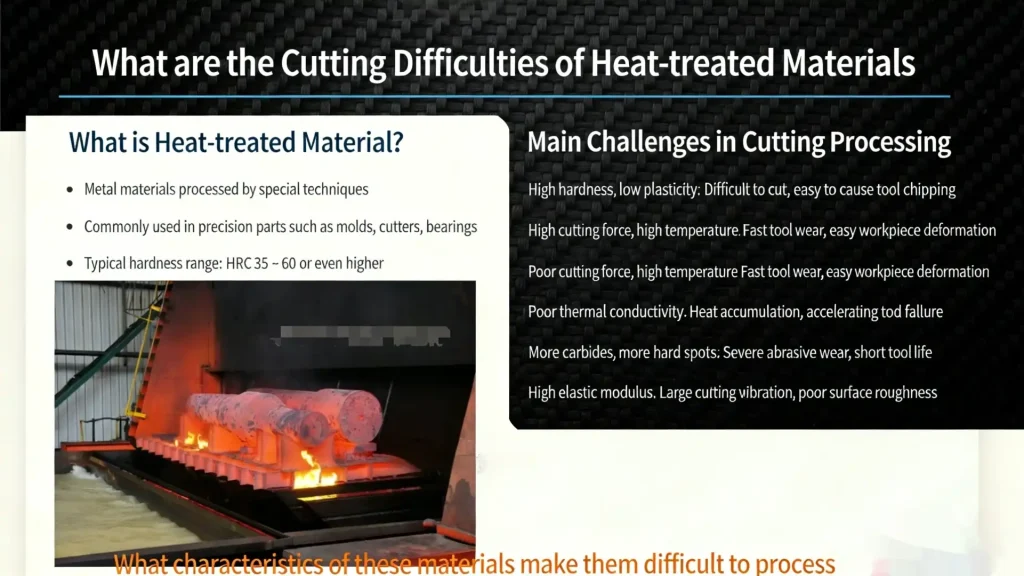
Carbides & Hard Points: Abrasive Wear Destroys Edges
And let’s not forget the carbides. Heat-treated materials are full of tiny, hard particles that act like sandpaper on your tool edges. Over time, they grind down the cutting edge until it’s useless. Plus, the high elastic modulus makes the material “bounce” during cutting—vibration goes up, surface finish goes down. Not fun.

How to Choose the Right Tool Materials (Carbide vs. CBN vs. PCD)
Now that we know the challenges, let’s talk solutions. The first step is picking the right tool material—this alone can double your tool life.
Solid Carbide: The Go-To for Most Heat-Treated Materials
For materials up to HRC 50 (like mold steel or alloy steel), solid carbide is your best bet. Look for ultra-fine-grain carbide—they’re tougher and more wear-resistant than regular carbide. If you need reliable tools that won’t break the bank, check out our high-performance Carbide Tool options. I use these for 90% of my jobs—they’re reliable and won’t break the bank.
CBN: The Heavy Hitter for HRC 50+
If you’re dealing with HRC 50+ steel (like brittle-hard tool steel or high-speed steel), skip carbide and go straight to CBN (cubic boron nitride). Solid CBN tools or indexable inserts work great—they handle the hardness without wearing out. I once used a CBN insert to mill HRC 60 steel for 8 hours straight—still sharp!

PCD: Not for Ferrous Metals (Don’t Waste Your Money)
PCD (polycrystalline diamond) is another option, but don’t even think about using it on ferrous metals or heat-treated materials. It’s only good for non-ferrous stuff like high-silicon aluminum. I’ve seen guys waste $200 on a PCD end mill for steel—total mistake.
Coating Secrets: Don’t Let Heat or Wear Kill Your Tools
Tool material is important, but coatings are the cherry on top. A good coating can make a carbide tool last as long as a CBN tool—if you pick the right one.
High-Temperature Coatings: AlTiN/AlCrN for HRC 50+
For materials over HRC 50 or interrupted cutting (like milling slots), go with high-aluminum coatings like AlTiN or AlCrN. They handle heat up to 1,000°C—no more coating flaking off mid-job. I use AlTiN for all my roughing jobs—works like a charm.
Nano-Layered Coatings: AlTiN/TiN for Abrasive Wear
If you’re dealing with lots of carbides (like tool steel), nano-layered coatings (AlTiN/TiN) are your best friend. Curious about how coatings affect tool life? Dive deeper into our Carbide Insights for more technical breakdowns.
Cutting Parameters: How to Balance Speed, Feed, and Tool Life
You can have the best tools in the world, but if your parameters are wrong, you’ll still waste time and money. Here’s how to set them like a pro.
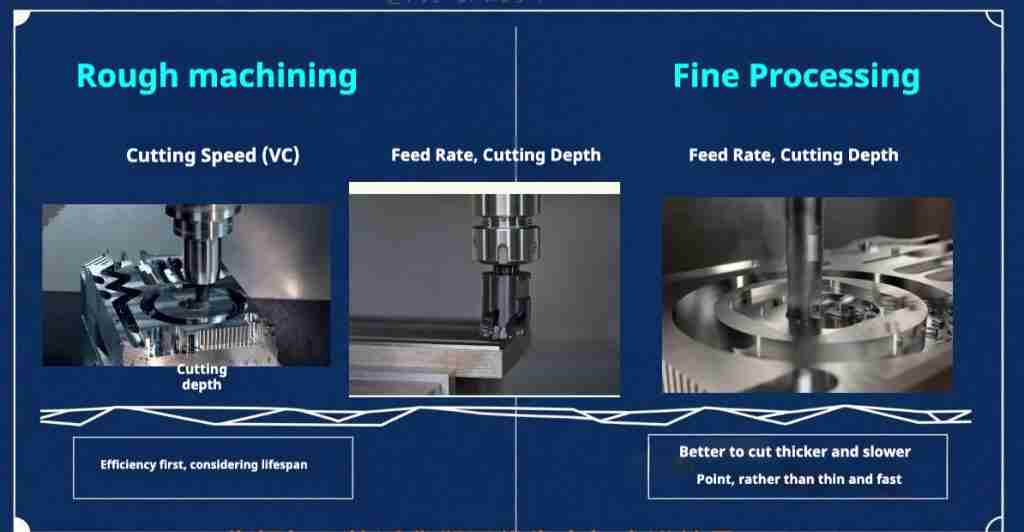
Roughing: Prioritize Feed Rate Over Cutting Speed
Roughing is all about removing material fast—without breaking tools. Forget cranking up the cutting speed—instead, increase the feed rate. Keep cutting speed moderate (100–150 m/min for carbide), feed rate steady (0.1–0.2 mm/tooth), and depth of cut slightly reduced (2–3 mm). For interrupted cutting? Slow down even more—thermal shock is a killer.
Finishing: Go Slow on Feed, Fast on Speed (But Not Too Fast)
Finishing is about surface quality. You can bump up cutting speed (150–200 m/min for carbide), but reduce feed rate (0.05–0.1 mm/tooth) to avoid chatter. Need more tips on parameter settings? Our Machining Knowledge section has detailed guides. Keep depth of cut super small—0.1–0.5 mm. Here’s a golden rule: cut thicker and slower instead of thin and fast. Why? Because thin cuts make the edge rub instead of cut—heat goes up, tool life goes down. Trust me, this saves so much time.
Machine Tool & Clamping: Rigidity Is Everything
Tools and parameters are important, but if your machine or clamping is flimsy, you’re doomed. Here’s what to do:
Get a Rigid Machine (No Cheap CNCs Allowed)

First, your machine needs to be tough. A high-rigidity machining center or CNC mill is a must—cheap machines vibrate, and vibration kills tools. I once tried to mill HRC 50 steel on a flimsy mill—total disaster. The machine shook so much, the tool broke in 2 minutes.
Use High-Rigidity Tool Holders (Shrink-Fit > Spring Collets)
Next, minimize tool overhang and use thick shanks. For tool holders, go with shrink-fit chucks or hydraulic chucks—they’re way more rigid than spring collets. I use shrink-fit chucks for all my end mills—no more tool runout, no more vibration.
Clamp Workpieces Like Your Life Depends On It
Finally, make sure your workpiece is clamped tight. Use heavy-duty vises or zero-point clamping systems—no movement, no vibration, no warping. I once had a part shift 0.1mm during milling—ruined the whole job. Now I double-check my clamps every time.
Cooling: How to Keep Your Tools (and Parts) From Overheating
Cooling is often overlooked, but it’s one of the most important parts of machining heat-treated materials. Here’s what works:
High-Pressure Internal Cooling: Direct Coolant to the Edge
If your machine has it, use high-pressure internal cooling. It shoots coolant right onto the cutting edge—way better than flood cooling. I use this for all my roughing jobs—cuts down on heat and extends tool life by 30%.
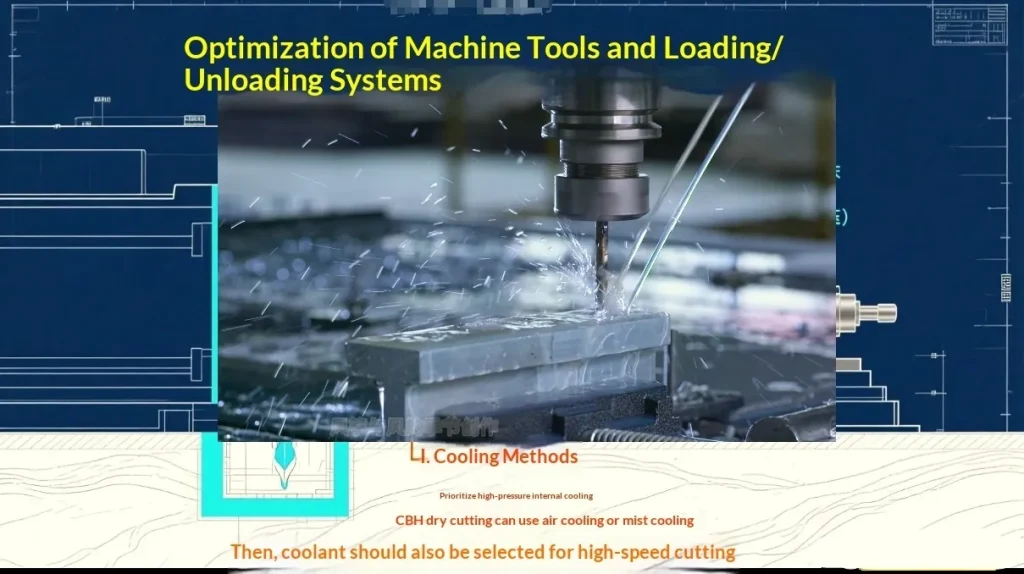
Choose the Right Coolant (Extreme Pressure Additives Are Key)
For coolants, go with cutting oils or emulsions that have extreme pressure (EP) additives. They reduce friction and prevent welding. I avoid water-based coolants for hard materials—they don’t handle heat well.
Dry Cutting with CBN: Minimal Cooling (No Thermal Shock)
If you’re using CBN tools, stick to dry cutting with minimal air cooling or oil mist. Too much coolant causes thermal shock—your tool will crack faster than a glass in the freezer. I learned this the hard way—once cracked a CBN insert because I used too much coolant.
Machining Sequence: Rough First, Heat Treat Later (Save Yourself Headaches)
Here’s a tip that’ll save you hours of work: do all your rough and semi-finish machining before heat treatment. Why? Because heat treatment makes the material hard—machining after heat treatment means more tool wear and slower speeds.

I once had a customer ask me to mill a HRC 55 steel part—they had already heat-treated it. It took me 8 hours to finish what should have taken 2 hours. If they’d rough machined it before heat treatment, they would have saved 6 hours and $100 in tool costs. Don’t make that mistake!
Milling Cutter Selection: What Works for Different Materials and Processes
Now let’s talk (milling cutters). Picking the right cutter for the job can make or break your project.

Roughing/Semi-Finishing HRC 35–50: 4–5 Flute Carbide End Mills
For materials up to HRC 50 (like mold steel), use solid carbide end mills with 4 or 5 flutes and a 35–45 degree helix angle. Browse our full range of Products to find the specific geometry for your application. They handle diverse jobs (contours, slots) without breaking. If you’re dealing with impact loads (like milling a slot with sharp corners), add a guide edge—this boosts impact resistance big time.
High-Efficiency Roughing: Indexable End Mills with TiAlN Coating
For large depths of cut (5–10 mm) and high feed rates (0.3–0.5 mm/tooth), use indexable end mills with P30/P40 carbide inserts and TiAlN coating. They’re made for high-efficiency roughing—perfect for when you need to remove lots of material fast. I use these for all my big jobs—saves so much time.
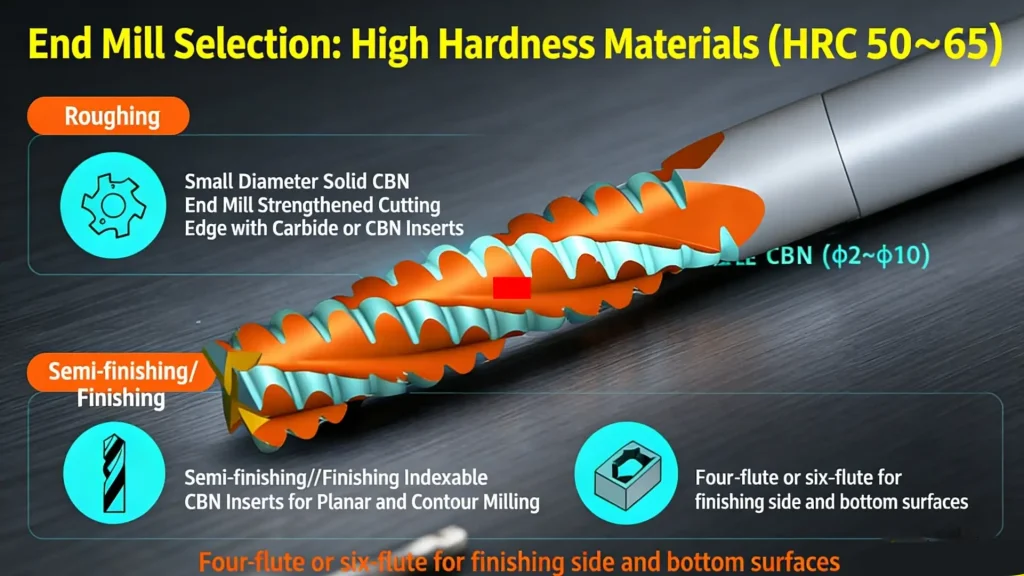
Finishing: Long-Cutting-Edge Carbide or CBN End Mills
Finishing is about precision. For side or bottom surfaces, use solid carbide end mills with 4–6 flutes, If you are looking for specific Carbide Cutter designs for finishing, we have precision options available. they give a smooth finish. For cavities or curved surfaces, go with ball-nose end mills. If you’re dealing with HRC 50+ steel, use small-diameter solid CBN end mills (2–10 mm)—they get the job done without sacrificing surface quality.
Final Tips: The 3 Core Principles to Boost Efficiency and Tool Life
Let’s wrap this up with three golden rules—follow these, and you’ll see a huge difference in your machining:

1. Match Tool Materials to Material Hardness
Use carbide for HRC 35–50, CBN for HRC 50+. Don’t cheap out on tools—this is where most people go wrong.
2. Set Cutting Parameters Smartly
Moderate cutting speeds, higher feed rates, and appropriate depths of cut. Remember: thicker and slower is better than thin and fast.
3. Optimize Rigidity and Cooling
Get a rigid machine, use high-rigidity tool holders, and cool effectively. And don’t forget—rough before heat treatment!
If you follow these three principles, you’ll cut faster, save money on tools, and get better results. Machining heat-treated materials isn’t easy, but with the right approach, it’s manageable. Ready to upgrade your tooling setup? Visit our Carbide Technical Hub for more resources, or Contact Us to discuss your specific machining challenges. Now go out there and make those tools last
What tool material should I use for hardened steel above HRC 50?
Above HRC 50, switch from carbide to CBN. Solid CBN handles the hardness carbide cannot. Use shrink-fit holders, confirm runout ≤ 0.010 mm, avoid intermittent coolant.
Which coating performs best when milling heat-treated steel at HRC 50+?
For HRC 50+ milling, use AlTiN or AlCrN — both handle cutting temps up to 1,000 °C. Avoid TiN on hardened steel; it fails rapidly under high heat and abrasive wear.
Should I machine the part before or after heat treatment?
Machine rough and semi-finish passes before heat treatment whenever possible. Cutting HRC 55+ post-treatment can triple cycle time and significantly increase tooling cost.


Request a Quote for Carbide Tools